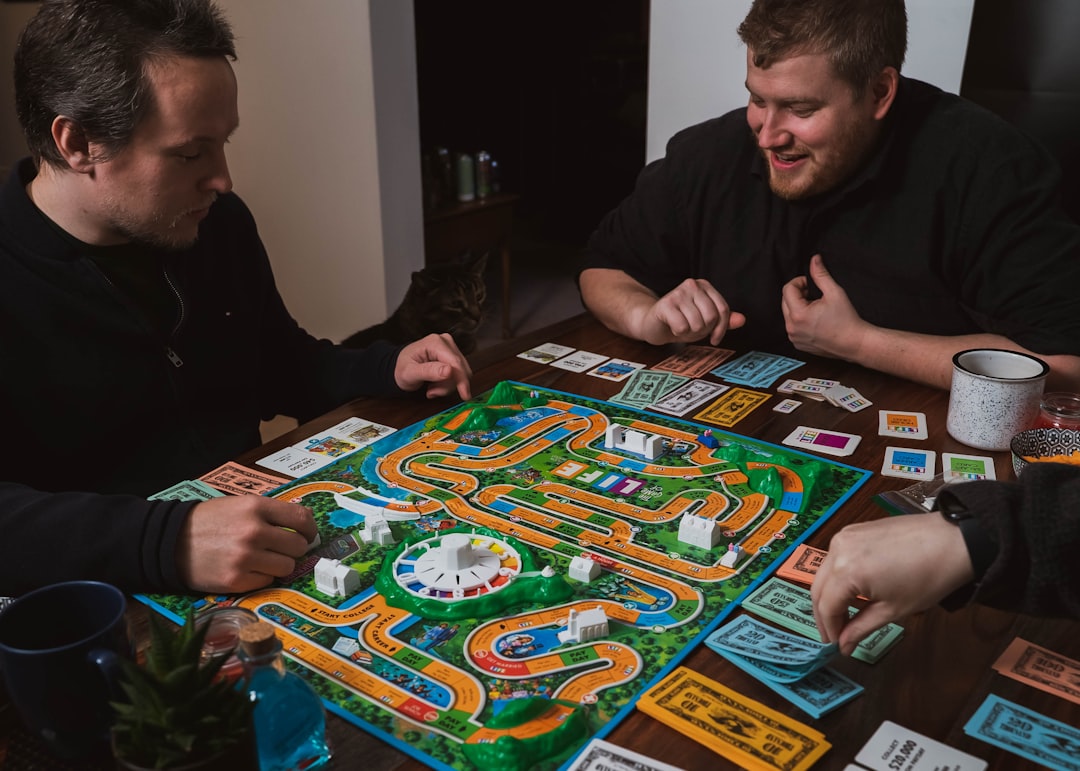
You have probably played a "multiplayer" game that did not feel very multiplayer at all. Everyone sits at the same table, everyone rolls dice or plays cards in turn, but nobody actually talks to anybody. Each player is quietly optimising their own little engine, glancing up occasionally to see who is winning. The box says four to six players. The experience feels like four to six people doing solo homework in the same room.
That is the problem with a lot of modern board games: the word "multiplayer" gets used loosely. This piece explains what genuine interactivity actually looks like, why some games generate noise and laughter while others generate silence, and how to spot the difference before you spend an evening (or £40) on the wrong box.
The interaction spectrum: from solitaire to full contact
Board game designers often talk about a spectrum running from low interaction to high interaction. It is worth understanding because it predicts, almost perfectly, what your games night will actually feel like.
At the low end sits what critics call "multiplayer solitaire." These are games where each player builds their own tableau, engine or city, and turns pass with minimal effect on anyone else. You can often play your entire turn without needing to look at the board state of the player next to you. Some deck-building games and tableau-builders fall here: they are excellent puzzles, but the puzzle is yours alone.
In the middle sits indirect interaction. Here, players share a common resource pool, a shared board, or a market that everyone draws from. Catan is the textbook example: you are not attacking anyone directly, but the shared board means someone else's settlement placement blocks your expansion, and the trading phase forces you to negotiate face to face. You cannot ignore the other players even if you wanted to.
At the high end sits direct interaction: games where your choices actively change what other players can do, and their choices change yours in return. Auction games like Power Grid put every player's bid in direct competition with everyone else's wallet. Negotiation and bluffing games go further still, because the entire mechanic is built on reading faces, making promises, and deciding who to trust. This is where a lot of the noise, laughter and (friendly) betrayal in games night actually comes from.
TL;DR
- Games sit on a spectrum from "multiplayer solitaire" (low interaction) to full negotiation and bluffing (high interaction)
- Shared boards and resource pools (Catan-style) create indirect interaction: you cannot ignore other players
- Direct interaction games (auctions, bluffing, negotiation) generate the most conversation and energy at the table
- Higher interaction is not automatically "better," but it is what makes a game feel social rather than solitary
Classifying popular games on the interaction spectrum
How well-known games sit on the low-to-high interaction spectrum
| Game | Interaction level | Why |
|---|---|---|
| Splendor | Low | Players build engines with limited direct interference beyond card scarcity |
| Ticket to Ride | Low-medium | Route blocking creates tension, but there is little direct negotiation |
| Catan | Medium | Shared board and mandatory trading phase force constant contact between players |
| Power Grid | Medium-high | Auctions put every player's money in direct competition each round |
| Smoothie Wars | High | Verbal bluffing and negotiation between rival stall owners drives every turn |
| Diplomacy | Very high | The entire game is negotiation, alliance-building and betrayal |
| Coup | High | Bluffing about hidden roles forces constant reading of opponents |
A tale of two games nights
A few months ago, a group of six friends sat down for a regular Thursday games night. The first game was a well-regarded tableau-builder: each player quietly built their own card engine, occasionally glancing at a shared scoring track. It was a genuinely clever design. It was also, by the third round, almost silent. People checked their phones between turns. One player admitted afterwards she had barely noticed who else was even winning.
The second game that evening was one built around open negotiation and bluffing over limited resources. Within ten minutes, two players were loudly accusing each other of reneging on a deal from the previous turn. A third was quietly building alliances by promising favourable trades three turns down the line. By the end, the table was standing up, gesturing, and arguing about who owed whom a favour. Nobody checked their phone once.
Both games were well designed. But only one of them turned a quiet Thursday into a story people were still telling the following week. That difference is not luck. It is interaction design.
The tableau-builders and engine games are wonderful puzzles, and I design plenty of them. But if you want a table to actually come alive, you need mechanics that force players to look at each other, not just at their own board. Verbal negotiation does something a card engine never can: it puts the social risk back into the game. People remember the deal that went wrong far longer than they remember the turn they optimised.
What does "multiplayer solitaire" mean in board games?
The phrase describes any game where the presence of other players barely changes your own decisions. You could, in theory, play most of your turn with the other players' boards hidden and lose almost nothing. It is not a criticism of quality: many multiplayer-solitaire games are excellent, focused puzzles. The criticism only applies when a game is marketed as a social experience but plays like several people doing separate crosswords at the same table.
Why do some board games feel more social than others?
Social energy in a game usually comes from uncertainty about what other people will do, combined with the ability to influence it. A shared market, a bluffing mechanic, or an open negotiation phase all create moments where you genuinely do not know what your opponent will do next, and where talking to them might change the outcome. Games without any of these elements can still be strategically deep, but they rarely generate the same table noise, because there is nothing to argue, negotiate or bluff about.
Does higher interaction always mean a better game?
Not necessarily. High-interaction games demand more from the group: everyone needs to be paying attention, willing to negotiate, and comfortable with a bit of confrontation. A quieter, low-interaction game can be exactly right for a relaxed solo-adjacent evening, or for players who prefer optimising their own plan without social pressure. The right choice depends on what kind of evening you want. But if the goal is a games night people talk about afterwards, interaction is usually doing the heavy lifting.
🔑 Key Takeaways
- ✓Check whether a game's turns actually depend on what other players do, not just the box copy
- ✓Shared boards and markets (Catan-style) create interaction even without direct confrontation
- ✓Bluffing and negotiation mechanics create the highest interaction, and the most memorable games nights
- ✓Match the interaction level to the mood you want: quiet focus versus loud, social chaos
- ✓A game can be brilliantly designed and still feel solitary if it lacks these mechanics
FAQs
Is a game with high player interaction harder to learn? Not usually. Interaction is about the mechanics that connect players, not the complexity of the rules. Many high-interaction games, including negotiation and bluffing titles, have simple core rules that are easy to teach in a few minutes, precisely because the depth comes from reading people rather than memorising systems.
Can a game be both strategic and highly interactive? Yes, and the best ones usually are. Games like Catan and Power Grid combine real strategic depth with constant player interaction. The interaction does not replace strategy, it adds a social layer on top of it.
Why do negotiation games sometimes cause arguments at the table? Because they are designed to. A good negotiation or bluffing game deliberately creates situations where trust can be broken for advantage. The mild tension that follows is usually part of the fun, provided everyone understands it is in-game rather than personal.
How can I tell if a game will be interactive before buying it? Look for keywords like "negotiation," "bluffing," "auction" or "trading" in the description, and check whether reviews mention players talking, arguing or making deals during play. A rulebook that spends more time explaining private engines than shared boards is usually a sign of lower interaction.
Are party games always more interactive than strategy games? Not always. Some party games are actually quite low-interaction once you strip away the theme, while some strategy games (like negotiation-heavy titles) are extremely high-interaction despite being marketed as serious strategy. It is worth checking the actual mechanics rather than the genre label.
If you have read this far wondering which category your own shelf falls into, it might be worth checking the negotiation and bluffing mechanics covered in our guide to bluffing and negotiation board games, or exploring how decision-making in board games mirrors real-world judgement and why simple-looking board games can hide surprising depth.
For more on the shared-board style of indirect interaction, see the mechanics behind Catan, or browse reviews and interaction ratings on BoardGameGeek.
Smoothie Wars was built around exactly this principle. Three to eight players run rival smoothie stalls on the same tropical island, and every turn depends on reading your rivals, striking deals, and deciding who to trust with your next move. It is a game built for the table to talk, not just take turns. Find out more about Smoothie Wars.