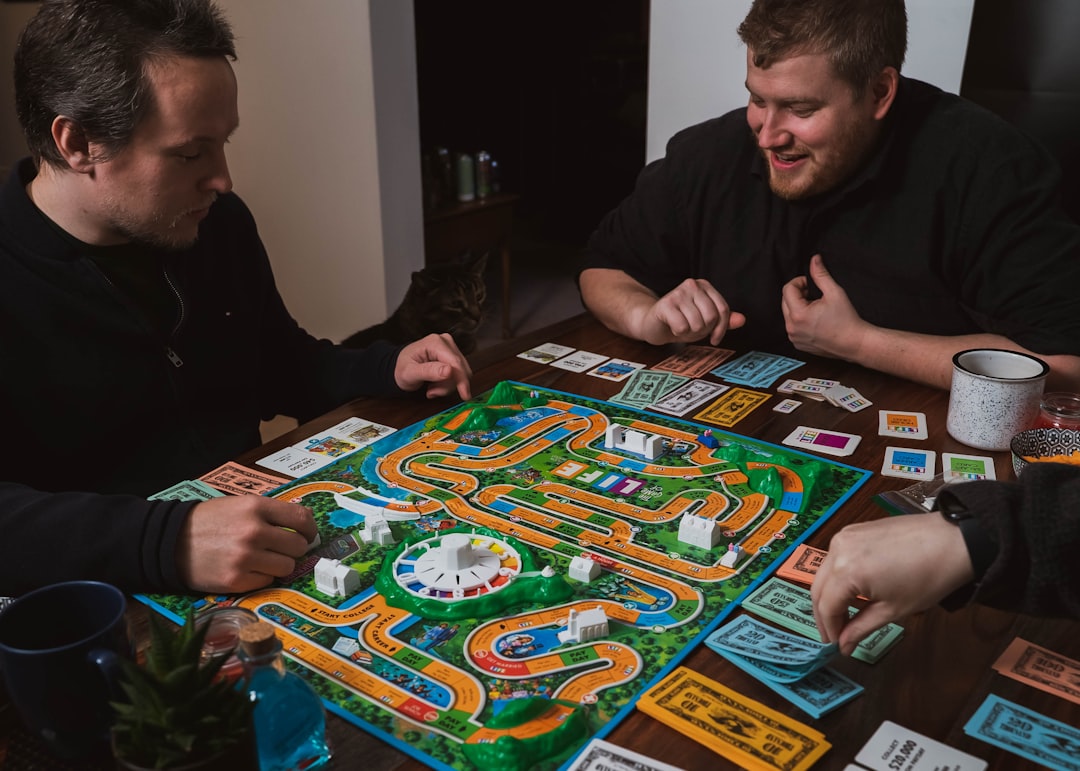
There is something different about a game where someone else has to lose for you to win.
Cooperative board games are wonderful. They bring people together, they remove the sting of being outplayed, and they are brilliant for certain groups. But competitive board games do something that cooperation simply cannot replicate. They sharpen you. They expose how you think under pressure. They force you to read other people honestly and respond to what you find. And when you win, it means something real, because your opponents were genuinely trying to stop you.
This guide is not a list of the best competitive board games on the market. It is something more practical: a breakdown of how strong competitive players actually think, and how you can start thinking that way too.
Why Competition Makes Games More Engaging
The answer is psychology, not game design.
When the outcome depends entirely on what other players choose to do, every decision carries genuine weight. You cannot plan a fixed route to victory. You have to adapt. That constant adaptation keeps your brain properly engaged in a way that cooperative or solo games often do not.
There is also the matter of stakes. Cooperative games spread the emotional weight of outcomes across the whole group. Competitive games place it squarely on individuals. That pressure is uncomfortable for some people, but it is also what makes a well-timed move so satisfying. The moment you outmanoeuvre a strong opponent, or successfully bluff someone into making a costly mistake, is genuinely thrilling in a way that folding cardboard cooperation rarely is.
The best competitive board games are also, perhaps counterintuitively, deeply social. Negotiation, persuasion, reading body language, choosing when to trust and when to deceive - these are all fundamentally human skills. Games that reward them tend to create the most memorable sessions.
The Psychology of Competitive Play
Reading Your Opponents
Most beginners focus almost entirely on their own position. Strong players spend at least as much time watching everyone else.
What are they doing with their resources? Are they hoarding, suggesting they are building towards something big? Are they spreading thin, which might mean desperation or aggression? Are they quiet and composed, or do they seem reactive and unsettled?
You do not need to be a body language expert. You just need to pay attention. Notice patterns over multiple turns. Notice when someone breaks from their pattern. That break usually signals something has changed for them, and that information is valuable.
Managing Your Own Emotions
This is harder than reading others, and more important.
Competitive games will frustrate you. Someone will take the route you needed. An opponent will benefit from your mistake. A plan you spent three turns building will collapse. How you respond to these moments largely determines whether you improve over time.
Strong competitive players treat bad luck and poor outcomes with the same analytical approach they apply to good ones. What went wrong? Was it foreseeable? What would you do differently? Players who get angry, quit mentally, or spend turns sulking instead of adapting are giving their opponents a free advantage.
Staying calm is itself a competitive strategy.
The Art of the Bluff
Bluffing is not deception for its own sake. In competitive board games, it is information management.
When you bluff well, you cause opponents to make decisions based on an inaccurate picture of the game state. That inaccuracy benefits you. The best bluffs in strategy games are not bold lies -- they are careful omissions, misleading framing, and confident action in the direction you want others to believe is correct.
Smoothie Wars is a strong example of how bluffing integrates with genuine strategy. Players negotiate openly, making verbal agreements about pricing and territory. But those agreements are not binding. A player might promise to keep their mango smoothie price high -- maintaining a shared premium market -- while privately planning to slash prices on the final day and scoop the profits. The table knows it might happen. The question is whether they believe it will, and whether they respond to the threat or ignore it.
That uncertainty is the heart of bluffing in negotiation-heavy games. You do not need to lie. You need to make the truth ambiguous enough that opponents cannot act on it with confidence.
Core Competitive Thinking Frameworks
Information Management
Every competitive game is, at its core, a game of incomplete information. You do not know what cards opponents hold, what resources they have saved, or what they are planning. Strong players try to maximise what they know while limiting what others can deduce about them.
Share information strategically. In negotiation games, never reveal your full position -- give enough to facilitate an agreement, not enough to expose your next three moves. Keep your reactions neutral. Do not let your face or body communicate what your position cannot afford to reveal.
Tempo and Timing
Tempo refers to whose turn it is to be proactive. A player with tempo is forcing others to react to them; a player without it is constantly playing catch-up.
Recognising when you have tempo -- and protecting it -- is a skill that separates good players from great ones. Sometimes the right move is not the most profitable action available, but the one that maintains your initiative and keeps opponents off-balance.
Timing applies equally to negotiation. In games like Smoothie Wars, the moment you propose an alliance matters as much as the terms you offer. A deal proposed when someone is struggling carries different weight than the same deal proposed when they are comfortable. Strong players choose their timing deliberately.
Opportunity Cost Analysis
Every choice you make in a competitive game costs you the alternatives you did not take. Strong players think about opportunity cost constantly.
If you spend three resources securing one location, you are implicitly deciding that every other use of those resources is less valuable. That might be correct. It might not be. Explicitly asking yourself "what am I giving up by doing this?" before each significant decision will sharpen your play noticeably. For a deeper look at how this applies specifically to resource decisions, the resource management guide covers the mechanics in detail.
Risk Assessment
Not all risks are equal, and treating them as such is a common mistake.
A high-risk move early in a game, when you have time to recover, is very different from the same move on the final turn, when you do not. Assess risk relative to your position and the stage of the game. Early on, take risks that might pay off handsomely. Late in the game, favour certainty unless you are already losing badly -- in which case risk becomes your only viable path.
Competitive Thinking Skills: A Practical Reference
| Skill | Why It Matters | How to Practise |
|---|---|---|
| Opponent tracking | You cannot respond to what you have not noticed | Narrate opponents' turns quietly to yourself |
| Emotional regulation | Tilt is a real phenomenon that costs games | Review frustrating moments after the session |
| Bluffing and misdirection | Creates profitable uncertainty for opponents | Play negotiation games regularly |
| Timing | The same move at different moments has different value | Replay key decisions in your head post-game |
| Opportunity cost thinking | Every choice closes alternatives | Ask "what am I giving up?" before each major action |
| Information hoarding | Reducing what opponents can deduce | Practise keeping your reactions neutral |
| Pattern recognition | Opponents repeat behaviours under pressure | Keep mental notes across multiple sessions |
Five Concrete Tactics for Winning More Often
1. Start with observation. Use your first two or three turns to gather information, even if it costs you some early efficiency. Knowing how opponents play is worth more than a slight positional advantage.
2. Choose one opponent to track closely. You cannot monitor everyone equally. Pick the player who seems strongest or most likely to threaten you, and focus your attention there.
3. Never take a negotiated agreement at face value. Assume the terms will hold right up until they do not. Build contingency into any deal you make.
4. Vary your play style between sessions. If you always play aggressively, opponents will adjust. Deliberately playing a patient, conservative game sometimes keeps opponents guessing and prevents them from anticipating your approach.
5. Review your losses honestly. Every loss contains more useful information than most wins. What did you miss? What did you assume incorrectly? Where did your plan break down, and why?
A Moment from the Island: An Anecdote
Six players. Final day. Smoothie Wars, set up at a kitchen table in Surrey on a rainy Saturday afternoon.
Tom had been sitting quietly in third place for most of the game, consistently undercutting competitors on coconut smoothies at the harbour location while making polite, almost deferential noises about not wanting to cause trouble. Nobody had threatened him seriously because he did not seem threatening.
On the final turn, Tom flooded three premium locations simultaneously with heavily discounted smoothies, collapsed the pricing structure two other players had spent four rounds constructing, and finished with nearly double the profit of the player in second place. He had been tracking the game state meticulously the whole time, managing perceptions as carefully as he managed his resources.
The table was stunned. Then someone laughed. Then everyone did. Because that is competitive board games at their best: the reveal that someone was thinking more clearly than you thought, all along.
If you want to understand the underlying economics of why that kind of move works, the supply and demand economics breakdown explains exactly how pricing dynamics play out across the game.
Competitive Board Games in the UK
The UK has a genuinely strong board game community. Tabletop game cafes have expanded considerably in cities like London, Manchester, Bristol, Edinburgh, and Leeds. Regular competitive events, from informal league nights to larger tournaments, run across the country through groups on Meetup, Reddit's r/boardgames UK community, and the BoardGameGeek forums.
The UK Games Expo, held annually in Birmingham, is the largest hobby games convention in the UK and a good place to try competitive games across a wide range of genres, play against strong players, and find local groups.
For those interested in games that genuinely develop transferable skills alongside competitive play, the business lessons from board games piece is worth reading. Competitive games like Smoothie Wars are increasingly used in educational and team-building contexts precisely because the skills they develop -- reading people, managing resources under pressure, negotiating -- translate directly into professional life.
How to Be Competitive Without Being Unpleasant
This matters more than most strategy guides acknowledge.
Winning at competitive board games should feel good. Losing should be tolerable, even interesting. The thing that makes both outcomes possible is how players treat each other.
Strong competitive players do not gloat. They do not dismiss others' moves. They do not explain, unprompted, what you should have done. They play hard within the game, and they leave the competition there when the game ends.
The best competitive players are also the ones most people want to play with again. That is not a coincidence. The social element of competitive games is inseparable from their appeal. Protect it.
Frequently Asked Questions
What is the most competitive board game?
It depends what kind of competition you enjoy. For pure strategy, Chess and Go have the deepest competitive traditions. For social competition with negotiation and bluffing, games like Diplomacy, Chinatown, and Smoothie Wars are excellent. For economic competition with direct conflict, Brass: Birmingham and Scythe are widely regarded as among the best available.
How do you get better at competitive board games?
Play regularly, review your decisions honestly after each session, and deliberately study the strongest player at the table rather than focusing only on your own position. Reading strategy guides -- including breakdowns like the strategy tips for board games -- accelerates improvement, but there is no substitute for repeated play.
Is bluffing in board games considered cheating?
No, provided the game's rules permit it. In games with open negotiation mechanics -- like Smoothie Wars, Diplomacy, or Cosmic Encounter -- bluffing is an explicit and intended part of the design. Outright lying about rules or game state is different and generally considered poor sportsmanship. Misrepresenting your intentions within the social and negotiation layer of the game is fair play.
What competitive board games are good for team building?
Games that involve negotiation, shared decision-making, and reading others work particularly well in team-building contexts because they develop genuinely transferable interpersonal skills. Smoothie Wars is well suited to this: it accommodates up to eight players, sessions run 45 to 60 minutes, and the business themes create natural discussion points about strategy, communication, and decision-making under pressure. Pandemic (cooperative) is a common choice for team building, but competitive games with negotiation elements arguably produce richer discussion afterwards.
How do I stop getting frustrated during competitive games?
Reframe what the game is measuring. You are not being assessed as a person -- you are running an experiment in decision-making. When something goes wrong, get curious about it rather than upset. The players who improve fastest are the ones who treat every loss as data rather than defeat.