TL;DR
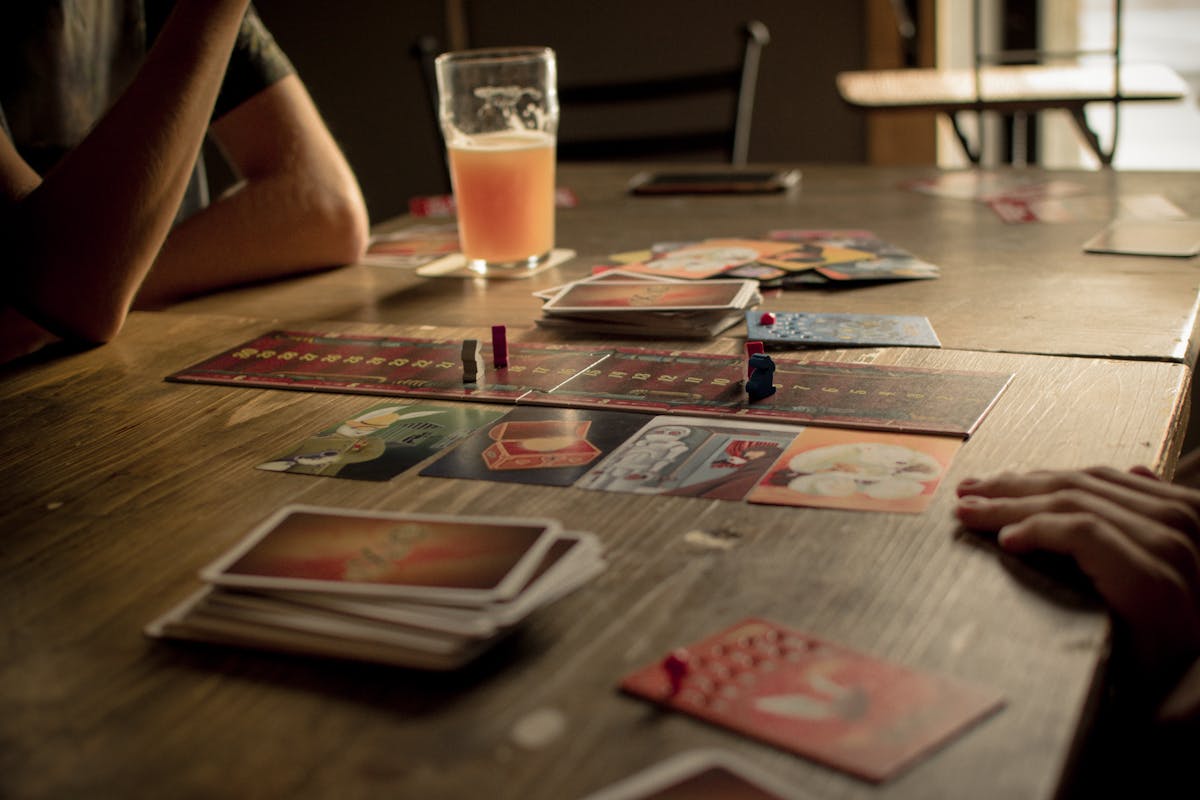
The best board games for 8 players are Smoothie Wars (best strategy game that scales to 8), Codenames (word guessing with teams), Dixit (creative and accessible), Secret Hitler (hidden role), and Wavelength (social deduction). Smoothie Wars is the rare strategy game that remains genuinely competitive at max player count — most strategy games deteriorate badly above five players.
Finding board games for 8 players is harder than it sounds. Many games marketed as "2–8 players" become slow, chaotic, or boring at maximum player count. Long waiting times between turns kill engagement. Elimination mechanics mean someone's sitting bored while everyone else finishes the game. And some games that work brilliantly at four players become incoherent at eight.
This guide only recommends games that are genuinely good with eight players — not games that technically support eight but weren't designed for it.
The 8-Player Problem
Before the recommendations, it's worth understanding why games for large groups are hard to get right.
The downtime problem: In a game where each player takes a five-minute turn, eight players wait 35 minutes between their own turns. That's not a board game session — that's an endurance test.
The chaos problem: Many games add player count as a scaling mechanism without considering the social dynamics. Eight-player hidden role games with poorly designed mechanics descend into shouting matches. Eight-player negotiation games without structure become unplayable.
The elimination problem: Games where players can be knocked out early leave someone watching others play for an hour. This actively damages group morale.
The games below avoid these failure modes by design.
Strategy Games for 8 Players
Strategy games that work at eight players are genuinely rare. Most strategy games deteriorate badly beyond five players — turns take too long, the board becomes chaotic, and the strategic coherence that makes them fun disappears.
Smoothie Wars — The Best Strategy Game for Up to 8 Players
Players: 3–8 | Time: 45–60 mins | Price: £34
Smoothie Wars is one of the few genuinely competitive strategy games designed to work at maximum player count. The genius of its structure is simultaneous decision-making: all players make their location, ingredient, and pricing decisions at the same time, so there's no waiting. With eight players, the game is arguably more interesting than with three — the market becomes intensely competitive, locations fill up quickly, and strategic positioning matters more.
Why it works at eight players:
- No turns to wait through — decisions are revealed simultaneously
- More players means denser competition and more interesting market dynamics
- The same 45–60 minute play time regardless of player count
- Elimination doesn't happen — every player competes through all seven rounds
Eight players at Smoothie Wars creates a chaotic, high-energy economic competition where nothing is predictable. Someone always ends up with a surprise last-turn push that overturns what looked like a settled winner. It's genuinely tense in a way that four-player games rarely achieve.
I designed for eight players from the start because I wanted the game to work for families and large friend groups without requiring them to split into smaller tables. The simultaneous mechanic was essential to that — if turns were sequential, eight players would be unworkable.
Best for: Families, mixed adult groups, anyone who wants a strategy game that's actually competitive at eight.
7 Wonders — Best Card-Drafting Strategy for 7 Players
Players: 2–7 | Time: 30 mins | Price: ~£35–40
7 Wonders is technically a seven-player maximum but worth including here as the best option if your group numbers seven. The simultaneous card drafting means everyone plays at the same pace with no downtime — a genuinely elegant design solution for large groups.
Note: With exactly 8 players, you'll need 7 Wonders Duel (designed for 2) and a separate game running in parallel, or a different choice altogether. Smoothie Wars remains the better pure eight-player option.
Party Games for 8 Players
Party games are inherently better suited to large groups, and these are the ones that actually work.
Codenames — Best for Team Play
Players: 2–8+ | Time: 15–30 mins | Price: ~£18–22
Codenames splits into two teams, each with a "Spymaster" giving one-word clues to guide teammates toward guessing the right words on a grid. It's clever, fast, and generates genuine moments of collective triumph and disaster.
Why it works at eight: Two teams of four creates exactly the right competitive tension. The team structure means there's always something to engage with, even when it's not your turn. Arguments about clues and guesses are half the fun.
Best for: Mixed groups, office parties, family gatherings.
Dixit — Best for Creative Groups
Players: 3–6+ | Time: 30 mins | Price: ~£25–35
Dixit is beautiful and weird. Players take turns as a storyteller, giving a clue about a surreal illustrated card. Everyone else plays a card that might match. The storyteller scores points only if some — not all — players guess correctly, creating a Goldilocks challenge.
Why it works at eight: The creative, low-competition format means large groups don't create chaos. It's forgiving enough that people who aren't naturally competitive gamers enjoy it, whilst the creativity reward keeps engaged players interested.
Best for: Groups that include non-gamers, creative types, anyone who doesn't want high-stakes competition.
Secret Hitler — Best Hidden Role Game
Players: 5–10 | Time: 45–60 mins | Price: ~£25–35
Secret Hitler is a hidden role social deduction game where Liberals and Fascists are secretly assigned, and everyone must work out who's who. At eight players, the information asymmetry becomes deliciously complex.
Why it works at eight: More players mean more deception, more false leads, and more social intrigue. The game is specifically calibrated for player counts of six to ten, so eight is genuinely its sweet spot.
Best for: Adults who enjoy social deduction, bluffing, and political intrigue themes.
Wavelength — Best Low-Stress Social Game
Players: 2–12+ | Time: 30 mins | Price: ~£25–30
Wavelength is one of those games that sounds too simple and turns out to be genuinely brilliant. A hidden dial sits on a spectrum between two concepts ("Hot" to "Cold," "Safe" to "Dangerous"). The clue-giver knows where on the spectrum the dial is set and must give a clue that points the team to the right zone. Teammates debate where the dial is.
Why it works at eight: Simultaneous team discussion means everyone is active and engaged. The debate about where a clue points is genuinely funny and revealing about how different people think.
Best for: Mixed groups, any occasion.
Games That Don't Work Well at Eight (And Why)
In the spirit of honesty: these popular games are often suggested for large groups, but they struggle at eight players.
Catan: The base game supports four players maximum. The extension goes to six, but strategic play deteriorates significantly even there. The long turns and complex interaction become unmanageable at eight.
Pandemic: As a cooperative game, eight players trying to make collective decisions creates analysis paralysis and "alpha player" syndrome, where one dominant voice takes over.
Ticket to Ride: The map gets impossibly congested at high player counts, and blocking becomes the dominant strategy rather than route-building. Not what the game's designed for.
How to Choose: A Quick Framework
| Group type | Best pick |
|---|---|
| Strategy enthusiasts, want competitive depth | Smoothie Wars |
| Mixed experience, want something everyone enjoys | Codenames or Wavelength |
| Creative and artistic groups | Dixit |
| Adults who like social deduction | Secret Hitler |
| Want quick, repeat-playable rounds | Codenames |
Practical Tips for Eight-Player Game Nights
Space matters. Eight players need a large surface. Most standard dining tables accommodate 6–8 comfortably for card-heavy games, but games with large boards (Catan, Ticket to Ride) need more space.
Explain rules once. With eight people, a 20-minute rules explanation is death to enthusiasm. Choose games with simple explanations (Codenames, Dixit, Smoothie Wars) or have one person learn the rules in advance and teach efficiently.
Plan for 2–3 games. A successful eight-player game night typically runs two or three shorter games rather than one long one. Start with something accessible (Wavelength or Codenames), move to something with more depth (Smoothie Wars) once everyone's warmed up.
Match the energy of the group. If people are excited and loud, Secret Hitler or Codenames channels that energy. If the group is quieter, Dixit's gentler competition suits the mood better.
Frequently Asked Questions
What is the best board game for exactly 8 players? Smoothie Wars is the standout strategy option specifically designed to work at eight players. For party games, Codenames (two teams of four) and Secret Hitler (ideal at six to ten players) are excellent choices.
Why do most board games struggle with 8 players? The main issues are downtime (long waits between turns) and chaos (too many players make strategic interaction incoherent). Games designed with simultaneous mechanics or team structures avoid these problems. Smoothie Wars uses simultaneous decision-making; Codenames uses team play — both solutions work well.
Can families with children play board games for 8 players? Yes, if the game is age-appropriate. Smoothie Wars works well for families with children aged 12+. Dixit and Codenames are accessible to younger children (10+) in a family setting. Avoid Secret Hitler and adult party games for mixed family groups.
Is Smoothie Wars really a strategy game at 8 players? Absolutely. The simultaneous mechanics mean eight players don't create downtime, and the market dynamics actually become more interesting — not more chaotic — with more players. Location selection, pricing, and investment decisions all carry more weight when eight people are competing for the same market share.
Looking for strategy games that work in smaller groups? Our best strategy board games for adults guide covers the best picks for two to six players.
For UK purchasing information, see our board games UK buying guide.
Ready to try the only strategy game that genuinely works at eight players? Smoothie Wars is available now in the shop — 45–60 minutes, 3–8 players, and genuinely competitive at every player count.