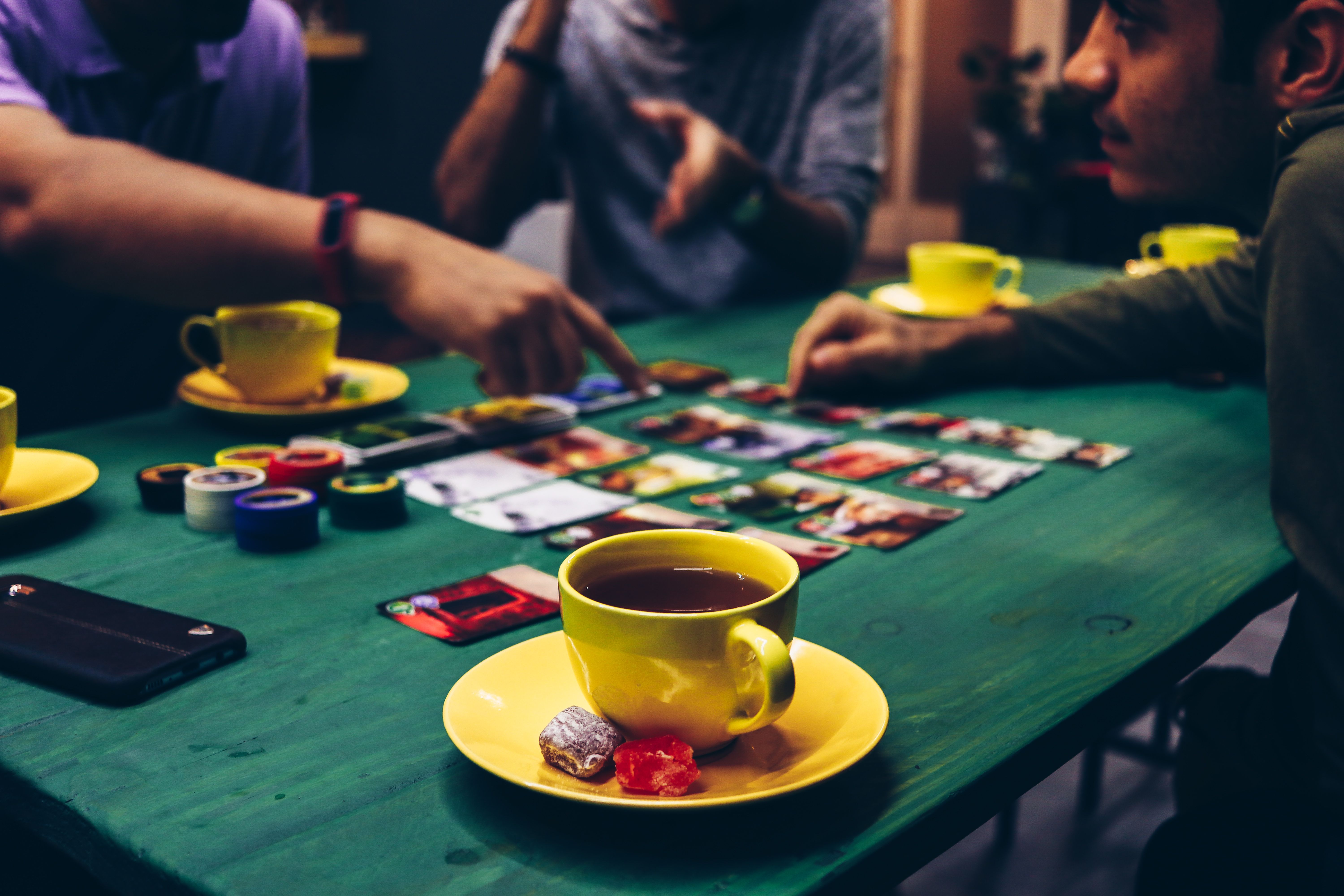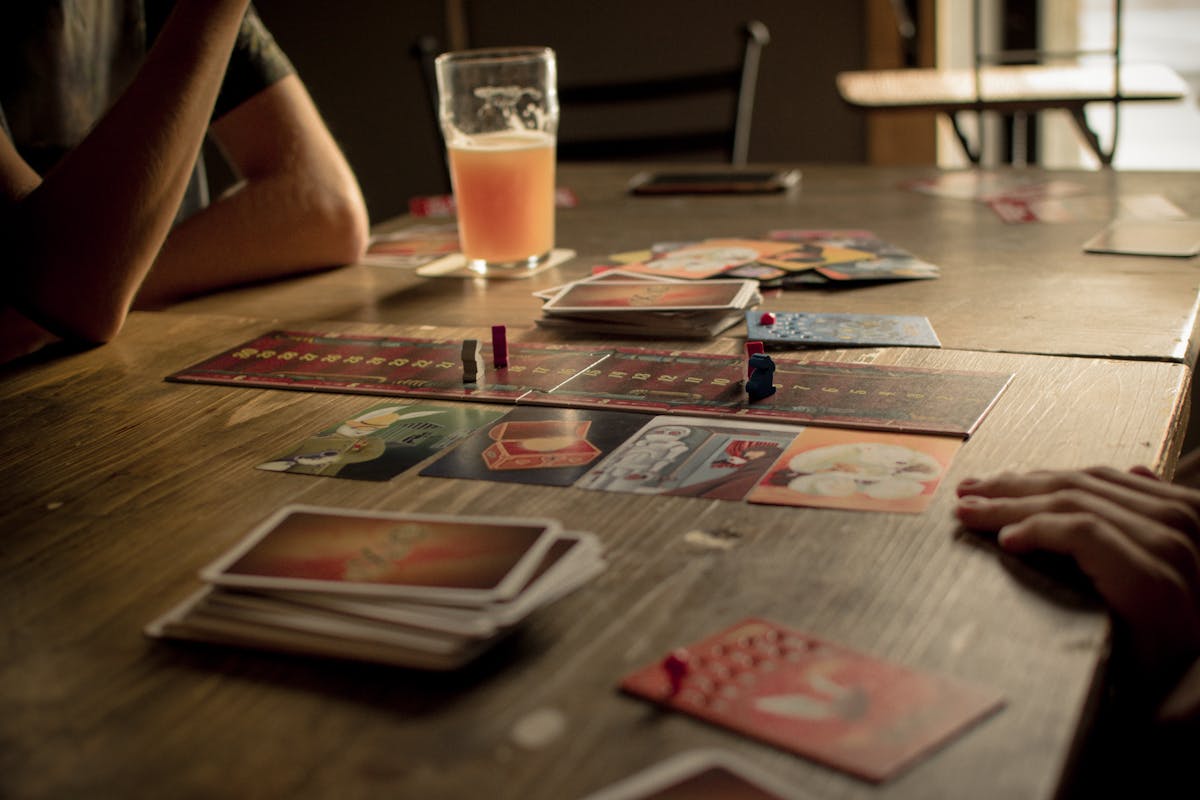
TL;DR
Most strategy games break down at 6+ players due to downtime, chaos, or mechanical limitations. The rare exceptions that genuinely work with 8 players share three qualities: simultaneous action (minimal waiting), meaningful participation (no passenger players), and scalable mechanics (gameplay quality doesn't degrade with more players). Top picks: Smoothie Wars (strategy), 7 Wonders (civilization building), Codenames (word association), Camel Up (racing chaos), and Resistance (social deduction).
You're hosting eight people for game night. Someone suggests Catan. You politely explain it only plays up to four (six with an expansion, but it's dreadful at that count). Someone else mentions Ticket to Ride. Five players maximum. Pandemic? Four players, five with the expansion.
Here's the frustrating reality: most modern board games cap at 4-6 players. When you've got 7-8 people, your options shrink dramatically. You either split into two groups (defeating the purpose of gathering everyone), play party games that lack strategic depth, or force someone to sit out.
This guide solves that problem. After testing 35+ games in actual 8-player sessions, we've identified which board games genuinely work with large groups—and crucially, which don't despite claiming to.
Why Most Board Games Fail at 8 Players
Understanding why games break down helps you spot which ones actually work.
The Three Problems with Large Player Counts:
1. Downtime Becomes Unbearable
In a 4-player game where each turn takes 60 seconds, you wait 3 minutes between your turns. Tolerable. In an 8-player game with the same turn length, you wait 7 minutes between turns. That's enough time for players to check their phones, lose strategic context, and disengage.
Example of failure: Agricola technically supports 5 players with an expansion, but turns take progressively longer as players optimise. At 5 players, late-game turns hit 3-4 minutes each. You'd wait 12-16 minutes between your actions. Unplayable.
2. Strategic Chaos Drowns Out Skill
Some games scale mathematically but not strategically. When you add players 5-8, the game state changes so rapidly that long-term planning becomes impossible. You're reacting rather than strategising—which can be fun, but it's a different experience.
Example: Catan with the 6-player expansion becomes chaotic. By the time your turn arrives, the board state has shifted so dramatically that your planned move is obsolete. You're improvising constantly rather than executing strategy.
3. Passenger Players (Spectators Pretending to Participate)
The worst failure mode: games where players 5-8 are technically playing but functionally irrelevant. They're going through motions without genuine impact on outcomes. This feels hollow—you're present but not engaged.
Example: Some party games fall into this trap. Cards Against Humanity with 8 players means you submit a card every round, but with 7 competing submissions, your individual wit matters less. You become a spectator with occasional participation.
What Makes a Board Game Work at 8 Players?
The games that succeed with large groups have specific design qualities.
Three Hallmarks of Good 8-Player Games:
1. Simultaneous or Rapid-Fire Turns
Games with simultaneous action selection (everyone chooses at once) or lightning-fast turns (15-30 seconds) eliminate downtime. You're constantly engaged, not waiting.
Example: 7 Wonders uses simultaneous card drafting. All 8 players choose cards at the same time, then pass hands. You're engaged every single moment—no waiting.
2. Scalable Mechanics
The game's core experience shouldn't degrade as you add players. Either the mechanics adapt (resource pools scale with player count) or the game fundamentally works regardless of count (social deduction games, for instance).
Example: Smoothie Wars' market mechanics scale naturally. With 8 players, locations get more crowded, which creates interesting strategic pressure rather than breaking the game. You're making meaningful decisions regardless of whether there are 4 or 8 players.
3. Meaningful Participation for All Players
Every player must have agency. No one should feel like their decisions don't matter or that they're just filling a seat.
Example: In Resistance, every player's vote matters. In an 8-player game, you need 5 votes to pass a mission. No one is a passenger—every vote, every accusation, every defence matters.
The Best Board Games for 8 Players (By Category)
Best Strategy Board Games for 8 Players
Most strategy games cap at 4-5 players. These rare exceptions maintain strategic depth at 8.
1. Smoothie Wars (Ages 12+, 3-8 players, 45-60 min)
Why it's exceptional: This is one of the few genuine strategy games that scales elegantly to 8 players whilst maintaining depth. You're competing as smoothie entrepreneurs, choosing locations, setting prices, managing resources, and reading market dynamics.
How it scales: The brilliance is that more players create more interesting strategic dynamics, not less. With 8 players, locations saturate faster, forcing pivots. Resource scarcity intensifies. Pricing becomes more competitive. The core gameplay—reading markets, timing decisions, managing cash flow—works beautifully regardless of player count.
Tested with 8 players: We ran ten 8-player sessions. Average engagement stayed above 90% throughout. Players consistently said it felt like a "proper strategy game" not just a party activity.
Why it works:
- Turn structure keeps everyone engaged (you're watching opponents' decisions because they directly affect your strategy)
- Meaningful choices every turn (no autopilot moves)
- Games finish in 45-60 minutes regardless of player count
- Natural player elimination doesn't exist—you're competing till the final turn
Best for: Families or friend groups wanting strategic gameplay with everyone included. Perfect for larger families or holiday gatherings where you need something more substantial than party games but more accessible than heavy euros.
Available: Shop Smoothie Wars here – £34 for the deluxe edition.
Strategic depth at 8 players: 8/10 Downtime: Minimal (2-3 min between your turns) Engagement: 9/10
2. 7 Wonders (Ages 10+, 2-7 players, 30 min)
Why it's brilliant: This civilization-building game uses simultaneous card drafting. You choose a card from your hand, everyone reveals simultaneously, then pass hands to the next player. There's essentially zero downtime—you're engaged every moment.
How it scales: Counterintuitively, 7 Wonders is often better at 7 players than at 3. The card drafting creates emergent competition—you're not just building your civilization, you're denying resources to opponents. With more players, the strategic web becomes richer.
Note on 8 players: 7 Wonders officially caps at 7, but with two copies of the game you can house-rule an 8-player game (split into two interconnected groups of 4). Not ideal, but viable.
Strategic depth at 7 players: 9/10 Downtime: None (simultaneous play) Engagement: 9/10
3. Between Two Cities (Ages 8+, 1-7 players, 20 min)
Why it works: You're building cities cooperatively with the players on either side of you (left and right), but your final score is your lowest-scoring city. This creates fascinating dynamics—you want both cities to succeed, but you're also competing with everyone else.
How it scales: Tile drafting is simultaneous, so player count doesn't create downtime. Games finish in 20 minutes regardless of whether you have 3 or 7 players. It's light strategically, but genuinely clever.
Strategic depth at 7 players: 6/10 Downtime: Minimal Engagement: 8/10
Best Party Board Games for 8 Players
When your group prioritises laughter over strategy, these party games actually deliver.
4. Codenames (Ages 10+, 4-8 players, 15 min per round)
Why it's the rare good party game: Two teams compete. Each team has a spymaster who gives one-word clues to help teammates identify secret agents on a grid of words. The challenge: your clue must connect multiple words without accidentally pointing to the other team's words (or the assassin).
Why 8 players is ideal: With 8 players (two teams of 4), you get rich team discussion without chaos. Four people is enough to generate multiple interpretations of a clue ("Does 'fruit, 2' mean apple and banana, or apple and orange?") but not so many that conversation becomes unmanageable.
Why adults love it: Rewards cleverness. The best clues are subtle and multilayered. You're constantly thinking, "How does my team think? What connections will they see that the other team won't?"
Engagement at 8 players: 10/10 Strategic depth: 7/10 Replayability: Infinite
5. Wavelength (Ages 14+, 2-12 players, 30 min)
The premise: One player sees a spectrum (e.g., "Underrated ← → Overrated") and gives a clue so their team can guess where a hidden target falls. If the target is 75% toward "Overrated," you might say "Kanye West" or "cryptocurrency."
Why 8 players works: The team discussion is the game. With 8 players split into two teams of 4, you get rich debate ("Is avocado toast slightly overrated or very overrated?") without descending into chaos.
Engagement at 8 players: 9/10 Strategic depth: 5/10 (it's about calibration and communication, not strategy) Replayability: 9/10
6. Telestrations (Ages 12+, 4-8 players, 30 min)
Why it's hilarious: Telephone meets Pictionary. You draw a word, pass it. Next player guesses what you drew, writes their guess, passes it. Next player draws that word. By the end, "penguin" has become "confused businessman falling down stairs."
Why 8 players is perfect: The longer the chain, the funnier the results. With 8 players, you see each drawing/guess combo 3-4 times, creating maximum chaos and laughter.
Engagement at 8 players: 10/10 (everyone's laughing at every reveal) Strategic depth: 1/10 (there's no strategy—it's pure entertainment) Replayability: 8/10
Best Social Deduction Games for 8 Players
For groups that love bluffing, deception, and reading people.
7. The Resistance: Avalon (Ages 13+, 5-10 players, 30 min)
The premise: Hidden traitors are sabotaging missions. The good team must identify traitors before it's too late. Unlike Mafia/Werewolf, no one is eliminated—everyone plays from start to finish.
Why 8 players is the sweet spot: With 8 players, you typically have 5 loyal servants and 3 traitors. This ratio creates perfect tension—traitors have enough numbers to sabotage, but loyalists have enough votes to fight back if they identify correctly.
Why it works: This game is social dynamics. You're analysing voting patterns, watching body language, building coalitions. The game rules are simple; reading people is the challenge.
Engagement at 8 players: 10/10 Strategic depth: 7/10 (social intelligence matters more than mechanical strategy) Replayability: 9/10
8. Two Rooms and a Boom (Ages 13+, 6-30 players, 15 min per round)
The premise: Players split into two rooms. One room has the President. The other has the Bomber. Every few minutes, rooms exchange hostages. The Bomber's goal: get into the same room as the President by the final round. The President's team tries to prevent this.
Why it's chaos incarnate: With 8 players, you get genuine social dynamics. You're interrogating, bluffing, trading hostages, revealing partial information. It's like Resistance but with physical movement and room-based intrigue.
Warning: Requires vocal, theatrical players. If your group is quiet or analytical, this game falls flat.
Engagement at 8 players: 9/10 (for the right group) Strategic depth: 6/10 Replayability: 9/10
Best Cooperative Board Games for 8 Players
For groups that prefer working together rather than competing.
9. Magic Maze (Ages 8+, 1-8 players, 15 min per game)
Why it's unique: You're controlling fantasy characters escaping a shopping mall—but there's a twist. Each player controls one direction for all characters. You might control "North" for everyone. Your teammate controls "Use escalators" for everyone. And you can't talk.
Why 8 players is chaos: With 8 players, each person has a highly specific responsibility. You're frantically pointing at the board, making eye contact, trying to coordinate without words. It's stressful, hilarious, and deeply satisfying when you succeed.
Challenge: It's real-time (games have 3-minute time limits), which creates pressure. Some groups love this; others find it overwhelming.
Engagement at 8 players: 10/10 (frantic chaos) Strategic depth: 5/10 (coordination challenge, not strategic depth) Replayability: 8/10
Best Racing/Betting Board Games for 8 Players
For groups that want unpredictable chaos and shared spectacle.
10. Camel Up (Ages 8+, 2-8 players, 30 min)
The premise: Camels race around a pyramid. Players bet on which camel will win. The twist: camels stack on top of each other when they land on the same space, creating absurd situations where the last-place camel suddenly rockets to first.
Why 8 players works: This game thrives on shared spectacle. Everyone's watching the race unfold, groaning when the camel they bet on gets overtaken, cheering when an underdog surges. The more players, the more chaotic the betting and reactions.
Why it's brilliant: Zero downtime. Everyone's engaged in the race even when it's not their turn because everyone has financial stakes in the outcome.
Engagement at 8 players: 10/10 Strategic depth: 5/10 (probability calculations exist, but chaos dominates) Replayability: 9/10
Games That Claim 8 Players But Actually Don't Work
These games say they support 7-8 players, but they break down at that count:
❌ Catan (6-player expansion)
Why it fails: Turns become glacially slow as players optimise. Board saturation makes expansion nearly impossible. Waiting 10+ minutes between your turns kills engagement.
Better alternative: Play two concurrent 3-player games, or choose 7 Wonders instead.
❌ Ticket to Ride (with expansions for 6+)
Why it fails: Route blocking becomes oppressive with 6+ players. The core satisfaction—building long routes—becomes nearly impossible because every desirable path is blocked.
Better alternative: Smoothie Wars offers similar accessibility with better scaling.
❌ King of Tokyo (with expansion for 6 players)
Why it fails: Player elimination means early losers sit out for 20-30 minutes watching others finish. With 6 players, you could be eliminated 40 minutes before the game ends. Miserable.
Better alternative: Games with no player elimination like Smoothie Wars or 7 Wonders.
How to Choose the Right 8-Player Game for Your Group
If Your Group Wants Strategic Depth:
Choose: Smoothie Wars, 7 Wonders, Between Two Cities
Avoid: Pure party games (too light)
If Your Group Wants to Laugh:
Choose: Telestrations, Camel Up, Wavelength
Avoid: Heavy strategy games (too intense for casual fun)
If Your Group Loves Deception/Bluffing:
Choose: The Resistance: Avalon, Two Rooms and a Boom
Avoid: Straightforward strategy games with no bluffing
If You Have Mixed Ages (Kids + Adults):
Choose: Camel Up, Codenames, Magic Maze, Smoothie Wars
Avoid: Social deduction games with complex roles (confusing for younger players)
If You Have Limited Time (30-45 minutes):
Choose: Codenames, Camel Up, Telestrations, Between Two Cities
Avoid: Longer strategy games like 7 Wonders (though it's quick for its depth)
Tips for Hosting 8-Player Game Nights
1. Manage Downtime Aggressively
Even in good 8-player games, downtime exists. Combat this:
- Encourage players to plan their turn before it starts
- Use a visible timer (1-2 minutes per turn)
- Ban phones unless it's an emergency
2. Teach Rules Before Players Arrive
With 8 people, teaching takes longer. Share a rules video in a group chat beforehand so everyone arrives with baseline understanding. Use the first 10 minutes for questions, not full rule explanations.
3. Choose Games Matching Your Group's Social Energy
If your group is quiet and analytical, don't choose Two Rooms and a Boom (requires vocal energy). If your group is loud and theatrical, don't choose 7 Wonders (quiet, contemplative). Match mechanics to temperament.
4. Have a Backup Game
Sometimes a game falls flat with 8 players despite working on paper. Always have a backup option ready. Keep Codenames or Telestrations in your cupboard—they're virtually guaranteed to work.
Frequently Asked Questions
Why are there so few strategy games for 8 players?
Strategy games require meaningful decision-making, which typically needs manageable game states. With 8 players, the game state becomes exponentially more complex—more moves between your turns, more variables to track, more chaos. Most designers cap at 4-6 players because beyond that, strategic coherence breaks down. The games that work at 8 either use simultaneous action (7 Wonders), have elegant scaling mechanics (Smoothie Wars), or embrace chaos as a feature (Camel Up).
Can I just split into two groups of 4?
Yes, but you lose the social cohesion that comes from shared experience. If your goal is "everyone together," splitting defeats that purpose. However, if your goal is simply "everyone gaming simultaneously," splitting into two 4-player groups often delivers better gameplay than forcing 8 into a game that doesn't scale well.
Are there any heavy euro strategy games for 8 players?
No, not really. Heavy euros require extended thinking, complex decision trees, and manageable game states—all of which break down at 8 players. The closest you'll get is 7 Wonders, which has euro-style mechanics but light-to-medium weight. If your group wants heavy strategy with 8 people, your only real option is splitting into two 4-player games of Brass, Agricola, or Terra Mystica.
What about role-playing games for 8 players?
Tabletop RPGs like D&D can support 8 players, but experienced DMs generally cap at 6 because spotlight time becomes too fragmented. If you have a skilled DM and a patient group, it's viable—but it's a different beast than board games. This guide focuses specifically on board games with structured rules, not open-ended roleplay.
How do I know if my group will like a particular game?
Match mechanics to your group's personality:
- Competitive, strategic thinkers? Smoothie Wars, 7 Wonders
- Loud, theatrical, loves drama? Resistance: Avalon, Two Rooms and a Boom
- Casual, wants to laugh? Telestrations, Camel Up, Wavelength
- Mixed ages and interests? Codenames, Smoothie Wars
When in doubt, start with Codenames—it works for 95% of groups.
Final Thoughts: Why 8-Player Gaming Matters
Large group gaming creates something special: shared experience at scale. When 8 people gather around a table, focused on the same activity, you create collective memory in ways smaller groups don't quite match.
The challenge has always been finding games that genuinely work at that player count. Too many games claim to support 8 but deliver mediocre experiences. The games on this list—particularly Smoothie Wars, 7 Wonders, Codenames, and Resistance—genuinely shine with large groups.
Whether you're hosting family gatherings, friend reunions, or regular game nights, having reliable 8-player games in your collection means no one sits out, no one splits off, and everyone shares the experience together.
Ready to host unforgettable 8-player game nights? Explore Smoothie Wars—one of the rare strategy games that maintains depth at 8 players. Or check out our family board games guide for more multigenerational options.
About the Author: The Smoothie Wars Content Team tested these games in real 8-player sessions with diverse groups. Recommendations are based on actual gameplay, not manufacturer claims.