TL;DR
The best board games ever made share a common quality: they create experiences that reward both mastery and curiosity simultaneously. Chess and Go earned their place through centuries of competitive refinement. Catan and Ticket to Ride democratised strategic gaming. Pandemic and Spirit Island proved cooperation could be genuinely tense. The games that will be remembered in fifty years are being released now — and the bar keeps rising.
Ranking the best board games ever made is a task with no clean answer. How do you weigh Chess — a game played for 1,500 years across every culture on earth — against Wingspan, released in 2019 and already recognised as a design landmark? How do you compare Pandemic's cooperative innovation against Catan's commercial revolution?
The answer is: you stop trying to create a single ranked list and instead acknowledge that different games earn their places for different reasons. This is an attempt at honest analysis rather than a definitive ordering.
The Ancient Games: Foundations of Play
Chess
To understand Chess is to understand something fundamental about human cognition. The game was developed in the 6th century in India (as Chaturanga) and reached its modern form by the 15th century. Since then, it has been played more than any other strategy game in human history.
Chess' genius is its absolute purity: no randomness, perfect information, infinite complexity. Two players with identical resources. The quality of thinking determines every outcome. The search space is so vast (more possible games than atoms in the observable universe) that Chess rewards a lifetime of study while remaining learnable in an afternoon.
What it established: That a game could be simultaneously accessible in concept and inexhaustible in depth.
Go
Go is almost certainly older than Chess and makes an equally strong claim to being the greatest game ever designed. Simple rules (place stones, surround territory) generate strategic complexity that exceeds Chess by many orders of magnitude. Go has never been fully solved by computer algorithms — the 2016 AlphaGo victory over professional players was achieved through neural network methods, not conventional calculation.
What it established: That territory, influence, and abstract spatial thinking could form the foundation of profound competitive experience.
The Modern Era: Reinventing Tabletop
Monopoly (1935) — The Cautionary Tale
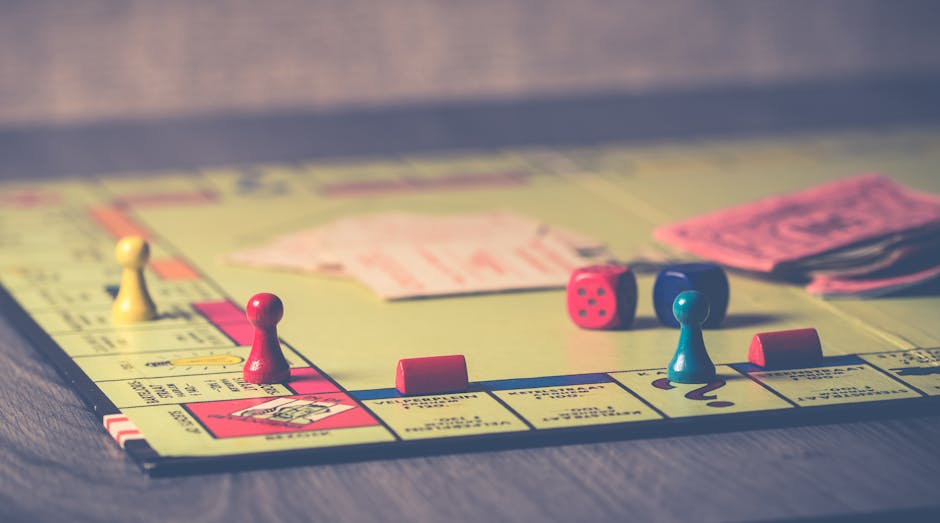
Monopoly belongs on any list of the most influential games ever made, though "best" is another question. Its influence is undeniable: it familiarised generations with the concept that board games could involve economic activity, property, and financial risk.
Its design, however, is flawed in ways that matter. Player elimination creates long stretches where participants are watching rather than playing. Luck dominates outcomes in ways that can't be mitigated through skill. Sessions regularly extend to three or more hours without conclusion.
Monopoly's enduring legacy is as a demonstration of the difference between cultural impact and design quality. It succeeded despite its flaws, not because of their absence.
Risk (1957)
Risk made global strategy accessible to households that had never heard of wargaming. Armies moved across a globe, alliances formed and shattered, and the end game often descended into dice-rolling attritional warfare.
Like Monopoly, Risk is more important than it is good. It introduced player elimination and luck-dominated combat at scale. But it also proved that adults would engage with territorial strategy and bluff at a kitchen table — a proof of concept for what came later.
The German Game Revolution: 1990s Onwards
Catan (1995)
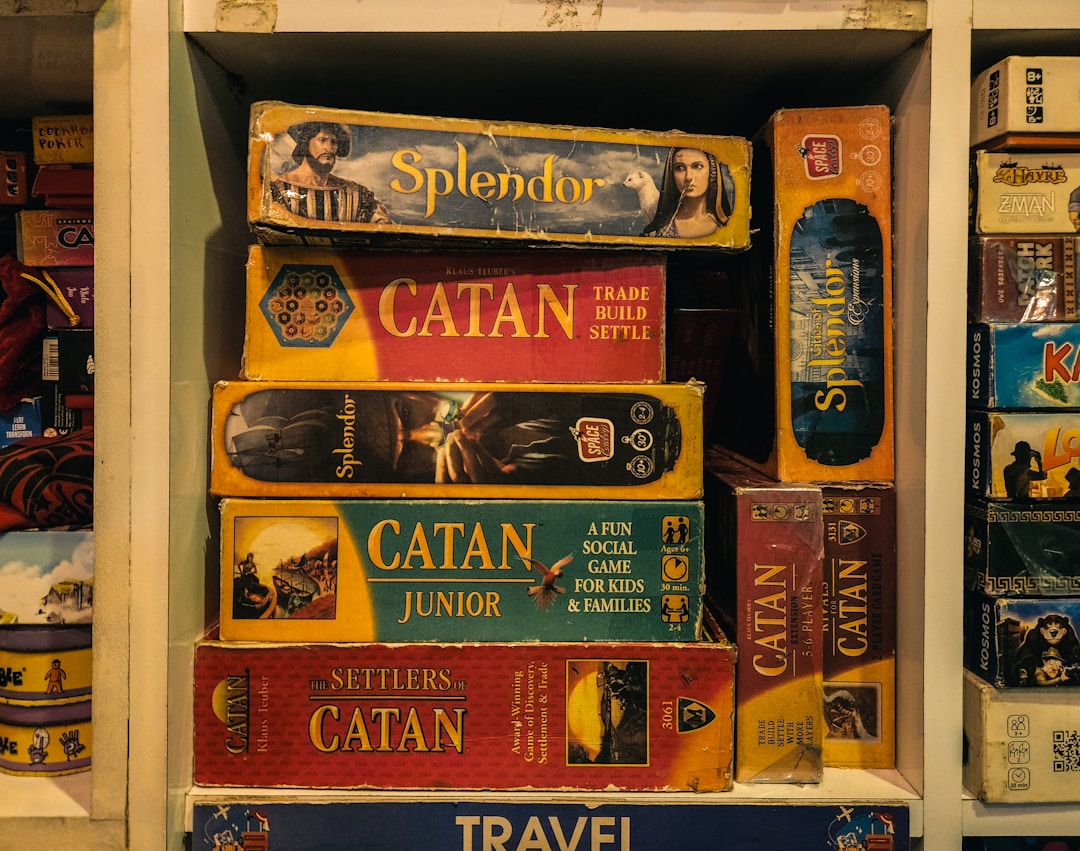
Klaus Teuber's masterpiece marks the precise moment the tabletop hobby's centre of gravity shifted. Catan proved that strategy games could be social, fast, and genuinely fun for people who weren't committed hobbyists.
The key innovations: no player elimination, a randomised board ensuring no two games are identical, a trading mechanic that made other players active participants in your strategy, and a session length that fit an evening rather than a weekend.
Catan has sold over 40 million copies. It sits alongside Chess and Monopoly in the handful of games that have genuinely shaped mainstream culture.
What it established: The template for the modern family strategy game.
Ticket to Ride (2004)
Alan Moon's train game is perhaps the most perfectly calibrated gateway game ever designed. The rules fit on a single page. The session is 60-75 minutes. The blocking mechanic creates genuine drama. Children and adults engage simultaneously and authentically.
Ticket to Ride didn't advance game design as dramatically as Catan, but it advanced accessibility. It remains the most reliable game to introduce to people who've never played a modern board game.
The Depth Games: Where Mastery Lives
Puerto Rico (2002)
Often considered the first true heavyweight of the European design tradition. Players develop a colonial Puerto Rico — roles, crops, shipping — in a game with no luck and extraordinary strategic depth. Puerto Rico's influence on subsequent game design is enormous: many of the role-selection and colonist-movement mechanics that define modern euros trace back here.
Puerto Rico's age has exposed design elements that are uncomfortable to contemporary players (the Colonial setting with "colonist" mechanics). Updated versions have addressed this. The underlying game design remains landmark-level.
Agricola (2007)
Uwe Rosenberg's farm-building game introduced the worker placement mechanism to mainstream gaming. Players struggle to feed their families while developing a farm — the scarcity tension and brutal resource competition made it one of the most demanding games of its era.
Agricola is not fun in the conventional sense. It is stressful and occasionally harrowing. It is also excellent.
Twilight Imperium (1997, 4th Ed 2017)
The most ambitious competitive board game ever produced. Six to eight players compete for galactic domination across six-plus hours of politics, economics, and military conflict. The scope is genuinely epic.
Playing Twilight Imperium is a commitment comparable to a sporting event. It rewards that commitment with an experience unavailable anywhere else in tabletop gaming.
The Modern Masterworks: 2015 Onwards
Pandemic (2008)
Matt Leacock's cooperative disease-fighting game doesn't belong in a "modern masterworks" section strictly speaking, but its influence accelerated through the 2010s. Pandemic proved that cooperative games could be genuinely tense, that shared goals could create as much drama as competition.
The game has extraordinary emotional intelligence. The sense of the world slipping out of control as outbreaks multiply feels genuinely urgent. Winning together feels genuinely satisfying.
Spirit Island (2017)
R. Eric Reuss' cooperative game is the most complex design in this guide and possibly the most accomplished. Players are spirits protecting a Polynesian island against colonial invasion. Each spirit has completely different abilities. Combinations of spirits create emergent strategic possibilities that no single play session can exhaust.
Spirit Island is genuinely difficult, deeply rewarding, and one of the most replayable games ever published.
Brass: Birmingham (2018)
Martin Wallace and Gavan Brown's redesign regularly occupies the top positions on Board Game Geek's rankings. Industrial revolution economic strategy, network building, resource management — executed with a precision that makes it feel like a perfectly tuned engine.
Wingspan (2019)
Elizabeth Hargrave's bird game should not work as well as it does. The subject matter is niche. The engine-building mechanism is well-established. And yet Wingspan is one of the most enjoyed games of the past decade, with production quality that elevated expectations for the entire industry.
Where New Games Fit
The genuinely difficult question for any "best ever" list is whether recent releases can legitimately appear alongside games that have decades of proven staying power.
The honest answer: not all of them. Many games that seem excellent on release reveal design flaws through extended play. Games that seem modest initially reveal unexpected depth.
Smoothie Wars sits in an interesting position. Dr Thom Van Every's economic competition game brings genuine innovation to the 3-8 player strategy space — a gap that has existed for decades. Its supply and demand mechanics are genuinely economic rather than abstracted. Whether it belongs on an "all time" list requires years of sustained play to establish. What's clear is that it addresses real unmet needs in the market and does so with design intelligence.
| Era | Landmark Game | Key Innovation |
|---|---|---|
| Ancient | Chess | Strategic purity, no luck |
| Ancient | Go | Territory and influence |
| 20th Century | Monopoly | Economic theme (problematic design) |
| 1990s | Catan | Social strategy, trading |
| 2000s | Ticket to Ride | Gateway accessibility |
| 2000s | Puerto Rico | Deep euro strategy |
| 2010s | Pandemic | Cooperative tension |
| 2010s | Spirit Island | Complex cooperative design |
| 2010s | Brass: Birmingham | Economic network perfection |
| 2020s | Wingspan | Production and accessibility |
FAQ
What is the best board game ever made?
Chess and Go both have legitimate claims based on longevity and strategic depth. In the modern era, Catan's cultural impact and Brass: Birmingham's design excellence are the strongest contenders. "Best" ultimately depends on what criteria matter most: accessibility, depth, longevity, innovation, or social experience.
Which board games have had the most influence on the hobby?
Chess defined competitive gaming. Catan defined the modern family strategy game. Pandemic defined cooperative design. These three, along with Dungeons & Dragons (not a board game, but the ancestor of modern tabletop RPGs), have shaped the hobby more than any others.
Are older board games better than new ones?
Not necessarily. Design quality has generally improved — modern games tend to have better rulebooks, better graphic design, more tested mechanics, and fewer design flaws than older titles. Several games from the 1990s and 2000s that were considered excellent have aged poorly by contemporary standards.
What makes a board game a classic?
Staying power and sustained quality across varied contexts. A classic game remains worth playing after a hundred sessions. It works across different groups. It rewards both new and experienced players. It generates conversation and memory. Very few games achieve all of these simultaneously.
Will any currently released games be considered classics in twenty years?
Almost certainly. Wingspan, Spirit Island, and Brass: Birmingham are the current strongest candidates based on their quality and reception. In the economic strategy space, games like Smoothie Wars that address real design gaps and bring genuine mechanical innovation will be worth watching.