TL;DR
Finding board games that genuinely work for mixed ages is harder than it sounds. This guide focuses on games where an eight-year-old, a teenager, and a grandparent can all be at the same table, all having fun, and all feeling like the game is actually fair.
The multigenerational family gathering is one of the hardest social puzzles in games. A seven-year-old wants something bright and simple. A thirteen-year-old wants something with genuine competition. Grandparents want something they can understand without extensive tuition and ideally something that allows for conversation during the game. Mum wants the evening to last more than twenty minutes. Dad wants to win.
Most games serve one of these needs very well. Very few serve all of them simultaneously. This guide is specifically about those rare games: the ones that genuinely work across a forty-year age span without anyone feeling like they are playing a game designed for somebody else.
Why Mixed-Age Games Are So Difficult to Design
The challenge is not making a game simple enough. It is making a game complex enough to be interesting for experienced players while remaining genuinely accessible -- not condescendingly simplified -- for younger ones.
A few principles distinguish successful mixed-age games from ones that fail.
Luck as a leveller, not a crutch. Some luck is valuable in mixed-age games because it prevents experienced players from dominating through superior strategy alone. But too much luck means the game feels arbitrary. The best games calibrate luck to create genuine tension and occasional upsets without reducing outcomes to randomness.
Turns that feel equal. When a ten-year-old's turn is structurally simpler than an adult's, they know it. Games that give everyone the same options feel fair; games that effectively give children a minor version of the adult game feel patronising.
Conversation opportunities. The best family games have natural pauses and moments where people can talk. A game that demands total cognitive focus from start to finish exhausts mixed-age groups. Games where you wait for your turn and can chat while others play work well for families.
Short session length. Three-hour game sessions are genuinely problematic for mixed ages. Under 90 minutes is the practical ceiling for most families, and under 60 minutes is better.
The Best Mixed-Age Board Games
Ticket to Ride
Ages: 8+ | Players: 2-5 | Time: 45-75 min
Ticket to Ride is one of the best-designed gateway games ever made and holds up exceptionally well for mixed ages. The goal -- claim train routes to complete journey tickets -- is immediately intuitive. The rules take about ten minutes to explain. And the tension of watching someone close off your intended route before you get there translates equally well whether you are eight or eighty.
The game gives every player the same options every turn. There is enough luck in the card draws to keep experienced players from dominating. And there is enough strategy in route selection to keep those same players engaged. That balance is unusual and valuable.
The Europe edition works particularly well because it adds the stations mechanic, which provides a small safety net for beginners who find themselves blocked.
Dobble (Spot It)
Ages: 6+ | Players: 2-8 | Time: 15 min
Dobble is worth including specifically because of how it levels the playing field. It is a pure speed game -- find the matching symbol between two cards as quickly as possible. Children often beat adults. That experience of a ten-year-old winning over a competitive parent is both humbling and joyful.
As a warm-up game before something more substantial, Dobble is perfect. It gets everyone laughing, removes any nervousness about playing, and takes fifteen minutes. Carry it to any family gathering.
Sushi Go Party
Ages: 8+ | Players: 2-8 | Time: 20-30 min
Sushi Go Party is a card-drafting game where players select cards from a hand being passed around the table. Each card is a type of sushi dish that scores points in different combinations. The art is charming, the rules are simple, and the game plays comfortably up to eight people.
The drafting mechanic -- seeing what others are choosing and adjusting your own picks accordingly -- is accessible from around age eight while still providing genuine strategic interest for adults. Games are short enough that if a young player loses, they are back in a new game within five minutes.
Smoothie Wars
Ages: 12+ | Players: 3-8 | Time: 45-60 min
For groups that include teenagers and adults, Smoothie Wars offers something the games above cannot: genuine competitive depth that engages experienced players fully while remaining accessible to newcomers. The business-themed premise -- selling smoothies on a tropical island -- sounds simple, and the rules reflect that simplicity, but the economic decisions embedded in the game create real strategic complexity.
At 12 and above, children can engage with the pricing and supply-and-demand mechanics in a way that feels meaningful rather than accidental. Grandparents often find that the trading and negotiation elements remind them of real business decisions in a way that creates unexpected points of connection with grandchildren.
The 3-8 player count is particularly useful for multi-family or extended family gatherings. Smoothie Wars at large player counts works without any of the waiting or reduced engagement that plagues most games at that scale.
Rummikub
Ages: 8+ | Players: 2-4 | Time: 45-60 min
Rummikub is a tile-based game where players build and manipulate number sequences on a shared playing field. It is one of the few games where older adults who grew up with tile games tend to have an advantage -- the spatial and pattern-recognition skills involved develop with experience rather than speed. This makes Rummikub unusual: it is a game where grandparents can genuinely dominate, which has its own value.
The rules are simple, the strategy is real, and games are naturally collaborative in the sense that players manipulate a shared arrangement of tiles.
Cluedo
Ages: 8+ | Players: 3-6 | Time: 45-75 min
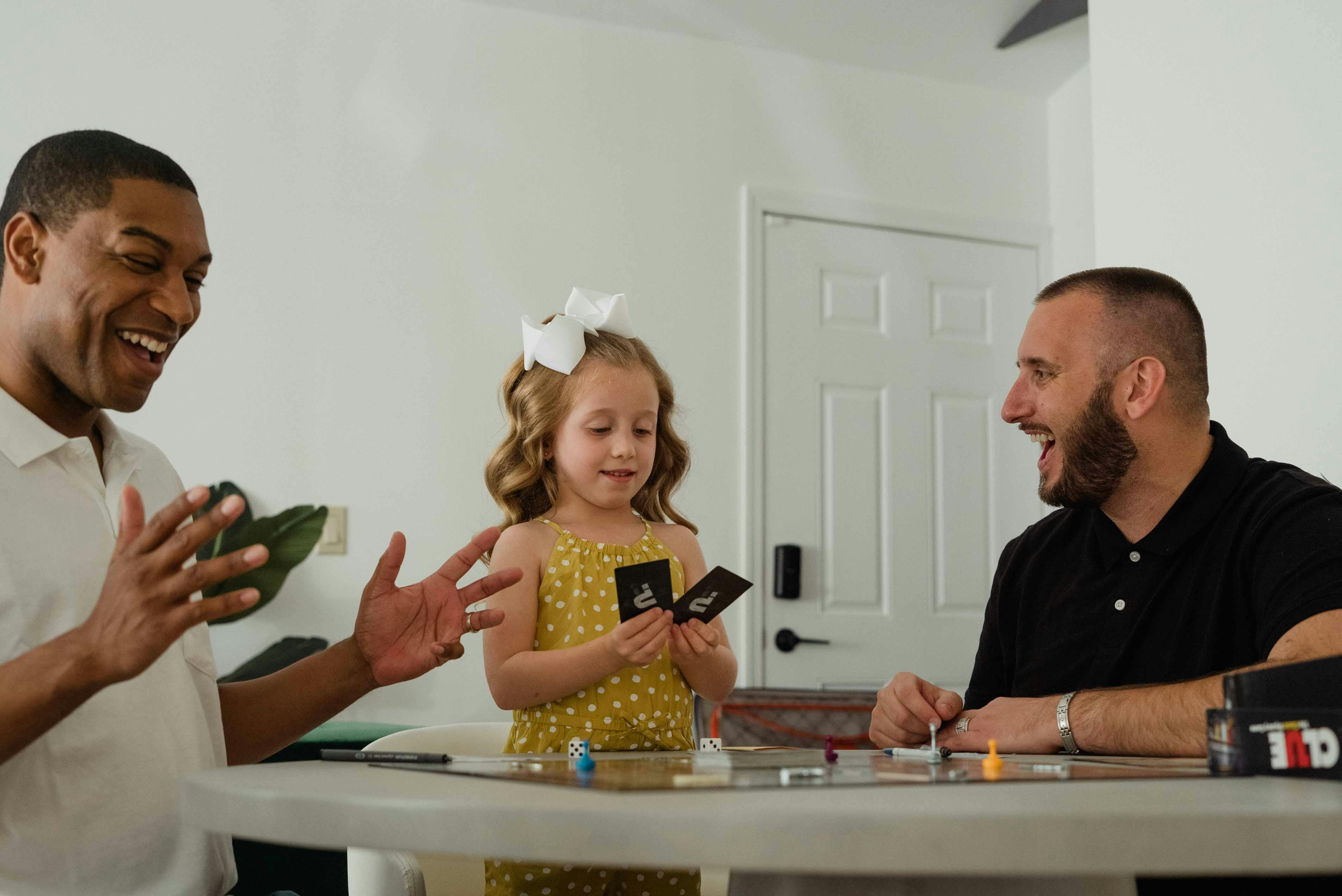
Cluedo has been bringing families together -- and creating arguments about accusation logic -- for generations. The deduction gameplay genuinely scales with age: children can participate and occasionally win while adults who apply more systematic deduction have a real advantage.
Its age is showing in some respects (the components are basic by modern standards), but the core gameplay loop is elegantly designed. For families with genuine nostalgia connection, it carries an extra layer of meaning when played with the next generation.
What Does Not Work for Mixed Ages
A few categories of game that sound like they should work, but typically do not.
Complex engine-building games. Games like Wingspan or Terraforming Mars are excellent for adult strategy groups but present a significant cognitive barrier for younger players. The complexity advantage enjoyed by experienced players is too large.
Games with reading or trivia advantages. Any game where broader knowledge or fast reading creates a structural advantage disadvantages children. These games are not really mixed-age games regardless of what the age label says.
Games over 90 minutes. Even teenagers and adults find their attention tested at the two-hour mark. For a mixed-age gathering, 90 minutes is the ceiling for a single game.
Games with player elimination. Removing someone from the game -- particularly a child who then has to watch others play for 30 minutes -- is reliably damaging to the mood of the whole evening.
Practical Tips for Mixed-Age Game Nights
Let younger players go first. This is a small but meaningful courtesy. Going first has inherent advantage in most games, and giving it to younger players sets a positive tone.
Pair children with adult partners for the first game. For very young players trying a new game, pairing with an adult who can advise (without dictating) smooths the learning curve. Once familiar with the game, they play independently.
Choose games where losing is fast. Short games or games without player elimination mean that a bad result does not create a long experience of exclusion. The goal is everyone playing, not everyone winning.
Have the right snacks. This sounds trivial. It is not. Snacks signal that the evening is an occasion, keep hands occupied between turns, and improve moods throughout. Do not underestimate this.
Follow the children's energy, not the clock. The best mixed-age game nights end when the youngest player starts flagging, not when the adults decide the evening is over. Reading the room and finishing on a high is worth more than squeezing in one more round.
The best mixed-age games are not the ones that strip out complexity for the sake of children -- they are the ones that create genuine points of connection across different ages. A game where a ten-year-old makes a clever play that an adult did not see coming, or where a grandparent uses decades of life experience to read the room better than everyone, creates something worth having.
That is what you are actually looking for: shared experiences where everyone feels capable, competitive, and genuinely present.
For families that include teenagers and adults, start with Smoothie Wars and Ticket to Ride. Add Dobble as the warm-up. You will have everything you need for a proper family game night.