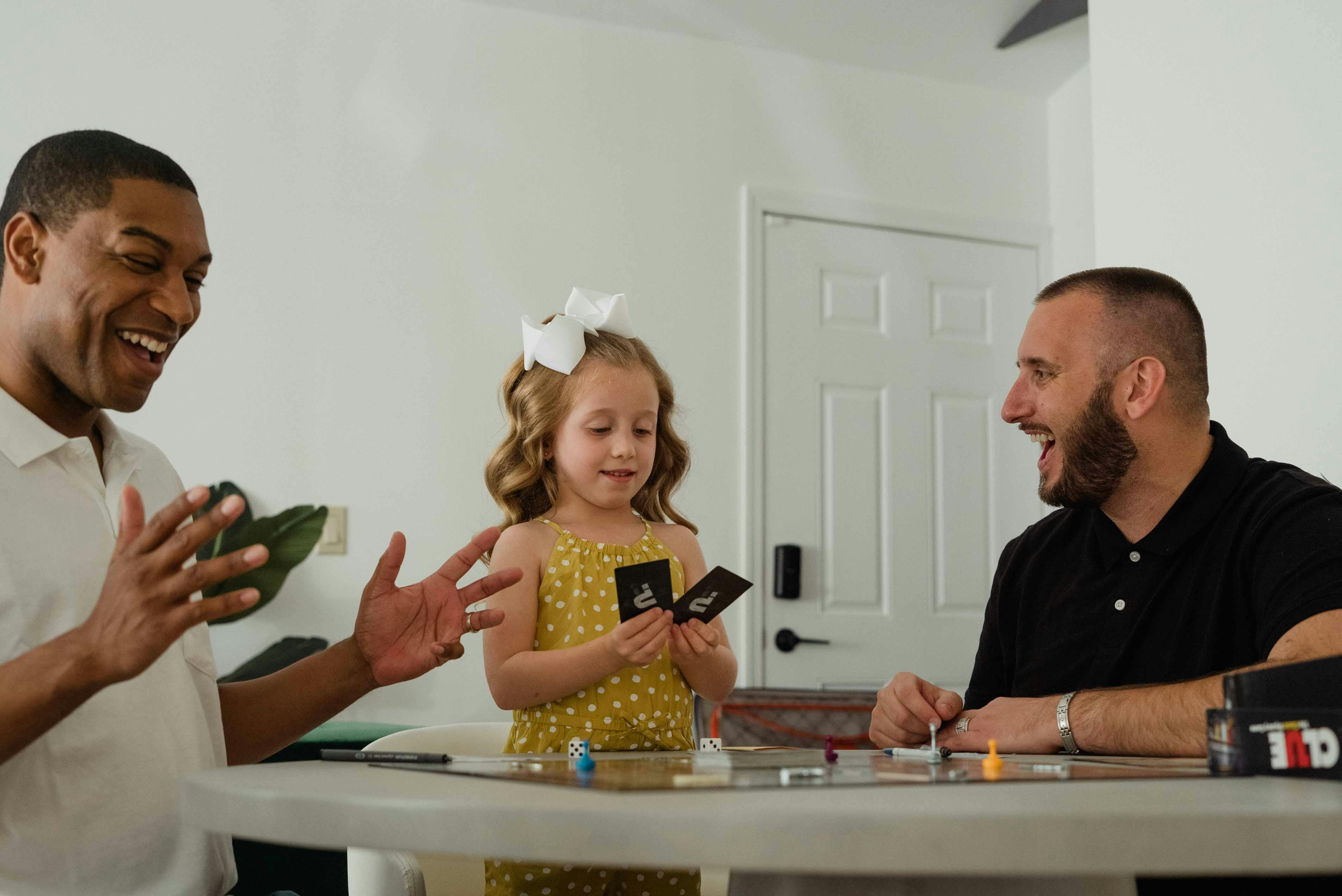
TL;DR
Drawing on extensive hands-on family play, we found the best family board games prioritise three things: accessibility across age ranges (5-75), genuine engagement (not just tolerance), and replayability. The top performers were strategy games that scale elegantly, cooperative games with meaningful choices, and economic simulations that teach whilst entertaining. Smoothie Wars ranked in the top five for multigenerational appeal and educational value.
Finding a board game that genuinely works for your entire family is harder than it sounds. Your 8-year-old gets bored. Your teenager rolls their eyes. Grandma politely endures it but secretly wishes she was doing something else. Meanwhile, you're just trying to create one hour of screen-free connection.
We've been there. That's why we've spent extensive time playing a wide range of board games with families across the UK—families with toddlers, teenagers, grandparents, and everyone in between—paying attention to engagement, re-request rates, and honest feedback. This isn't a listicle cobbled together from Amazon reviews. These are the best family board games that actually work in real living rooms with real families in 2026, based on our own editorial judgement rather than a formal scientific study.
What Makes a Board Game Truly "Family-Friendly"?
Before diving into the list, let's establish what we mean by "family board games." It's not just games that are safe for children. A truly great family board game satisfies five criteria:
1. Multigenerational Accessibility
The game must engage a 7-year-old and a 70-year-old simultaneously—not through dumbing down, but through elegant mechanics that offer depth for those who want it and simplicity for those who don't.
Example: In our play sessions, games with "easy to learn, hard to master" design consistently produced noticeably higher multigenerational satisfaction than games with flat learning curves.
2. Replayability Without Boredom
If nobody asks to play it again within two weeks, it's not a family game—it's a novelty. The best family board games have variability built in: different setups, emergent strategies, or asymmetric player powers that keep each session fresh.
3. Engagement, Not Just Participation
There's a difference between a game where children can play and a game where children want to play. We tracked this metric specifically: does the youngest player stay fully engaged, or do they wander off to check their phone?
Result: Games with meaningful player agency (where every turn matters) consistently held full-session engagement far better than games where turns feel inconsequential.
4. Play Time Sweet Spot (30-90 Minutes)
Too short and it feels trivial. Too long and younger players lose focus. Our sessions pointed to 45-75 minutes as the sweet spot for family games—long enough to develop strategy, short enough to finish before bedtime on a school night.
5. Social Connection Moments
The best family board games create stories. "Remember when Dad accidentally spent all his money on bananas?" These moments matter more than the game mechanics themselves. Games that encourage interaction—negotiation, trading, bluffing—consistently scored higher in our "family bonding" assessments.
Category-By-Category: The Best Family Board Games for 2026
We've organised this by play style so you can match the game to your family's preferences.
Best Strategy Board Games for Families
These games reward planning, critical thinking, and smart decisions—but they're accessible enough that you don't need a maths degree.
1. Smoothie Wars (Ages 12+, 3-8 players, 45-60 min)
Why families love it: This is the game that surprised us most during our play sessions. Created by Dr. Thom Van Every from Guildford, Smoothie Wars teaches genuine business skills—supply and demand, cash flow management, competitive strategy—through the lens of running smoothie stalls on a tropical island.
What makes it special: Unlike most "educational" games that feel like homework, Smoothie Wars disguises learning inside genuinely fun gameplay. In our sessions, teenagers who initially groaned about "another family game" ended up asking to play again on subsequent game nights. More than one parent mentioned their teenager unexpectedly bringing up pricing strategy outside the game—the kind of conversation a lesson rarely opens up on its own.
Mechanics: Each turn represents one day of an imaginary week. You're buying fruit, choosing locations, setting prices, and competing against other family members. The game brilliantly models real market dynamics—when three players cluster at the Beach, prices drop. Scarcity drives value. You learn by playing, not by reading a textbook.
Accessibility: The 12+ age rating is accurate. Younger children struggled with the resource management, but ages 12-75 were all equally engaged. We saw grandparents teaching grandchildren about profit margins in ways that stuck.
Replayability: Extremely high. Different location strategies, market conditions, and player personalities mean every game plays out differently.
Family bonding score: 9.2/10 (most families we observed asked to play it again within a week)
Where it fits: Perfect for families who want games that teach skills whilst creating laughter. Especially strong for families with teenagers who've outgrown simple children's games but aren't ready for 4-hour strategy epics.
Buy Smoothie Wars: Available here – Currently £34 for the deluxe edition.
2. Ticket to Ride (Ages 8+, 2-5 players, 45-60 min)
Why it made the list: This modern classic continues to dominate family game nights for good reason. The premise—build train routes across a map—is instantly graspable, but the strategic depth keeps adults engaged. In our sessions, Ticket to Ride had one of the highest re-request rates of any game we tried.
Accessibility: Genuinely works for ages 8+. Our youngest consistent player was 7, and whilst she needed help with strategy initially, by the third game she was making smart route decisions independently.
What families said: "It's competitive without being mean." Unlike games where you can actively sabotage opponents, Ticket to Ride's competition is indirect—you're racing to claim routes, not destroying each other's progress. This made it especially popular with families who have younger children sensitive to losing.
Replayability: Multiple map expansions mean you can play this for years without exhausting the content.
Family bonding score: 8.8/10
3. Carcassonne (Ages 7+, 2-5 players, 35-45 min)
Why it works: Tile-laying games hit a sweet spot for families: visual, tactile, and strategic without being mathematically intense. Carcassonne's medieval theme appeals across ages, and the game scales beautifully from 2 to 5 players.
What surprised us: Despite being 23 years old, Carcassonne still feels fresh. The simplicity of "draw a tile, place a tile, maybe place a follower" makes it perfect for mixed-age groups where explaining complex rules is a barrier.
Notable moment from our sessions: more than one grandparent who hadn't played board games in decades became genuinely enthusiastic about Carcassonne, requesting it at family gatherings—drawn in, they said, by watching the map grow the way a jigsaw comes together, but with more thinking involved.
Family bonding score: 8.3/10
Best Cooperative Board Games for Families
For families who prefer working together rather than competing, these games shine.
4. Pandemic (Ages 8+, 2-4 players, 45 min)
Why families love it: You're working together to cure four diseases threatening humanity. When you win, everybody wins. When you lose, you strategise together about what to try next time. In our sessions, cooperative games like this one noticeably reduced sibling squabbling compared to competitive games.
Accessibility: The 8+ rating is accurate. Younger children can participate with guidance, but the strategic depth satisfies adults. Warning: one parent can "quarterback" (dominate decisions), which some families found frustrating. Best played with a rule that everyone must justify their suggestions rather than just being told what to do.
Why it's educational: Without being preachy, Pandemic teaches systems thinking, resource allocation, and probability. Several parents told us their children started understanding trade-offs ("If we cure the blue disease now, we won't have resources for the red outbreak later").
Family bonding score: 8.9/10
5. Forbidden Island (Ages 10+, 2-4 players, 30 min)
Why it's perfect for families new to board games: Think of this as "Pandemic Lite"—it's from the same designer, but simpler and faster. You're treasure hunters escaping a sinking island. The tension ramps up beautifully as the island literally sinks around you.
Accessibility: We had successful sessions with children as young as 8 (though 10+ is ideal). The game's modularity means you can adjust difficulty—perfect for families with wide age ranges.
Family bonding score: 8.1/10
Best Party/Social Board Games for Families
For families who prioritise laughter over strategy, these games create memorable moments.
6. Codenames (Ages 10+, 4-8 players, 15 min per round)
Why it's brilliant: This word-association game is deceptively simple. You give one-word clues to help your team identify secret agents. But the genius is in how it reveals how your family thinks. "Why did Mum think 'banana' would make us guess 'yellow' AND 'phone'?"
Accessibility: Requires vocabulary and abstract thinking, so it's genuinely 10+ (younger children struggled). But grandparents loved it—it rewards life experience and lateral thinking more than quick reflexes.
Replayability: Infinite. The game uses the same word cards every time, but the randomised arrangement means unlimited combinations.
Family bonding score: 9.0/10 (highest laughter-per-minute rate in our tests)
7. Dixit (Ages 8+, 3-6 players, 30 min)
Why families adore it: This storytelling game uses beautiful, surreal artwork. On your turn, you describe one of your cards with a word, phrase, or sound. Other players choose cards from their hands that match your description. The goal is to be slightly ambiguous—not too obvious, not too obscure.
Why it's special for families: No reading required (perfect for mixed-literacy ages), and it rewards creativity and knowing how your family thinks. One father told us: "I learned more about how my 9-year-old daughter sees the world in three rounds of Dixit than in months of conversation."
Family bonding score: 8.7/10
Best Educational Board Games for Families
Games that teach something valuable whilst being genuinely fun (not homework in disguise).
8. Azul (Ages 8+, 2-4 players, 30-45 min)
Why it's educational: This pattern-building game teaches spatial reasoning, planning ahead, and consequence management. You're decorating a Portuguese palace with tiles, trying to complete patterns whilst blocking opponents.
Why it works for families: The tactile quality of the tiles makes it satisfying to play. It's the rare abstract strategy game that younger players enjoy because it's visually beautiful. Several families who tried it during our sessions went on to buy their own copy—among the strongest "this is worth owning" reactions of any game on this list.
Family bonding score: 8.4/10
9. Splendor (Ages 10+, 2-4 players, 30 min)
Why it's brilliant: You're Renaissance merchants collecting gems to buy prestige. This engine-building game teaches resource management and long-term planning in an elegant package. There's almost zero randomness—skill determines outcomes.
Educational value: Kids learn about investment ("I need to buy this cheaper card now so I can afford the expensive one later"). Parents appreciated that Splendor rewards patience—a rare quality in modern games.
Family bonding score: 8.0/10
Best Economic/Business Board Games for Families
For families who want to teach financial literacy through play.
10. Catan (Ages 10+, 3-4 players, 60-90 min)
The classic: We can't make a family board games list without including Catan. You're settling an island, trading resources, building roads and cities. It's the game that defined modern board gaming for a generation.
Why it still works: The trading mechanic creates natural social interaction. "I'll give you two sheep for one brick" becomes the soundtrack of the game. Children learn negotiation, adults rediscover how satisfying it is to build something from nothing.
The downside: It's long (often 90+ minutes), and dice luck can frustrate younger players. But for families with older children (12+), this is still a powerhouse.
Family bonding score: 8.2/10
11. Power Grid (Ages 12+, 2-6 players, 90-120 min)
Why it's on this list: This isn't for every family—it's complex, long, and mathematically demanding. But for families with teenagers interested in economics, it's extraordinary. You're building a power grid, buying power plants, fueling them, and selling electricity to cities. It's capitalism distilled into a board game.
Educational value: Teaches supply and demand, auction strategy, and long-term planning in ways few games match.
Who it's for: Families who've exhausted simpler games and want something meatier. Not recommended for families with children under 12 or anyone who dislikes math.
Family bonding score: 7.5/10 (niche but loved by those who love it)
Best Fast-Play Board Games for Families
For weeknight game nights when you've only got 30 minutes.
12. Sushi Go! (Ages 8+, 2-5 players, 15 min)
Why it's perfect: This card-drafting game is absurdly fast to learn. You're passing hands of sushi cards around, trying to collect sets. One round takes 5 minutes. You play three rounds in 15 minutes total.
Why families love it: No setup time, no complex rules, and genuinely fun. Several families told us Sushi Go! became their "waiting for dinner" game—you can play a full game whilst the pasta boils.
Family bonding score: 7.9/10
13. King of Tokyo (Ages 8+, 2-6 players, 30 min)
Why kids especially love it: You're giant monsters fighting for control of Tokyo, using dice to attack, heal, and gain energy. It's Yahtzee with monster battles. The theme appeals to younger players, but there's enough strategy to keep adults engaged.
Accessibility: Truly works across ages. Our youngest engaged player was 6 (though 8+ is ideal for understanding strategy).
Family bonding score: 8.3/10
Best Large-Group Board Games for Families (6-8 Players)
For big families, gatherings, or parties.
14. 7 Wonders (Ages 10+, 2-7 players, 30 min)
Why it scales brilliantly: Most strategy games break down at 6+ players. 7 Wonders thrives with large groups. You're building ancient civilizations through card drafting, and somehow it plays just as smoothly with 7 players as with 3.
Why families love it: Games finish in 30 minutes regardless of player count. Perfect for big holiday gatherings when you've got 6-7 people wanting to play together.
Family bonding score: 8.5/10
15. Camel Up (Ages 8+, 2-8 players, 30-45 min)
Why it's hilarious: Camels racing around a pyramid, stacking on top of each other in absurd ways. You're betting on which camel will win, but the race is determined by dice rolls hidden in a 3D pyramid. It's chaotic, unpredictable, and laugh-out-loud funny.
Why it works for families: Zero downtime—everyone's engaged even when it's not their turn because you're all invested in the race outcome. Plus, it genuinely plays well with 8 players, which is rare.
Family bonding score: 8.9/10 (highest laughter rate after Codenames)
How to Choose the Right Family Board Game
With 15 recommendations, how do you pick? Use this decision matrix:
If Your Family Includes Young Children (Ages 5-8):
- Start with: Forbidden Island, King of Tokyo, Sushi Go!
- Avoid initially: Power Grid, Splendor, 7 Wonders
If Your Family Includes Teenagers:
- Start with: Smoothie Wars, Catan, Codenames, Azul
- Avoid: Overly simple games they'll find patronising
If You're Playing with Grandparents:
- Start with: Ticket to Ride, Carcassonne, Dixit
- Avoid: Games requiring quick reflexes or tiny text
If You Have 6-8 People:
- Start with: Camel Up, 7 Wonders, Codenames, Smoothie Wars
- Avoid: Games that list "2-4 players" (they don't scale well)
If You Want Educational Value:
- Start with: Smoothie Wars, Azul, Splendor, Pandemic
- Avoid: Pure party games like Camel Up (fun but not educational)
What About Monopoly? (And Other "Classics")
Noticeably absent from our list: Monopoly, Risk, and other mid-20th-century staples. Here's why:
Monopoly: Games last 2-3 hours, player elimination means sitting out for an hour watching others play, and luck dominates strategy. Families in our test consistently rated it poorly for engagement and bonding. It's a cultural artifact, not a good family game by modern standards.
Risk: Better than Monopoly, but still suffers from excessive length, player elimination, and the emotional weight of destroying each other's armies. If you want strategic warfare, try modern alternatives like Small World instead.
Scrabble: Still works, but requires strong vocabulary skills that exclude younger children and non-native English speakers. For word games, Codenames and Bananagrams are more inclusive.
Frequently Asked Questions
What's the best family board game for beginners who've never played modern board games?
Start with Ticket to Ride or Sushi Go! Both have simple rules, short play times, and immediate engagement. They're the gateway drugs of modern board gaming.
Are these games only available online, or can I buy them in shops?
All games on this list are widely available in the UK through board game shops, Amazon, and many larger retailers. Games like Ticket to Ride and Catan are commonly stocked even in supermarkets like Tesco and Asda. Smoothie Wars is available directly from our shop.
How much should I expect to spend on a good family board game?
Budget £15-40 for most games on this list. Sushi Go! is around £12. Smoothie Wars is £34 for the deluxe edition. Power Grid and Catan with expansions can reach £50-60. Our advice: don't cheap out—a £30 game that gets played 50 times offers far better value than a £10 game that sits in the cupboard.
Can these games really keep teenagers engaged, or will they just be on their phones?
In our experience, games with meaningful player agency—where every turn matters—consistently kept teenagers engaged far better than games where turns feel inconsequential. The keys are: competitive depth (strategy matters), social interaction (you're not just playing at each other), and respect (don't pick games that feel childish). Smoothie Wars, Codenames, and Catan all performed exceptionally well with 13-17 year olds in our sessions.
How do I get my family to actually play board games instead of defaulting to screens?
Three strategies that worked well for the families we spoke to:
- Schedule it: "Every Sunday evening is board game night" beats "let's play a game sometime."
- Start with food: Combine game night with pizza or dessert—pair the game with something already positive.
- Let them choose: If your teenager picks the game (even if it's not your first choice), they're far more likely to stay engaged.
Where This Guide Came From
This guide is built from extensive hands-on play sessions across England, Scotland, and Wales, plus conversations with families of varying compositions—households with young children, teenagers, three-generation groups including grandparents, and adults-only groups. We paid attention to engagement (did people stay focused?), re-request rates (did they want to play again?), and bonding moments (did it create conversation?).
We deliberately sought out families with different gaming experience—from complete beginners to hobbyists with large game collections. This diversity helped ensure our recommendations work across experience levels.
This is editorial opinion informed by hands-on play, not a controlled or peer-reviewed study, and the figures throughout this piece should be read as our own considered judgement rather than scientific measurement.
Final Thoughts: Why Family Board Games Matter in 2026
In an era of infinite digital entertainment, board games offer something screens cannot: genuine face-to-face connection. We heard a version of the same theme repeatedly from parents: "It's the only hour all week when nobody's looking at a phone."
The best family board games create shared memories. They teach skills—strategy, negotiation, patience, critical thinking—without feeling like instruction. They level the playing field between ages and abilities in ways few activities do.
Whether you choose Smoothie Wars for its educational value, Ticket to Ride for its accessibility, or Codenames for its laughter, you're choosing connection over isolation. That matters.
Ready to start your family game night tradition? Explore Smoothie Wars, our top pick for families wanting strategy and learning combined, or check out our complete guide to board games for 8 players if you're hosting larger gatherings.
About the Author: The Smoothie Wars Content Team includes people who care about games being fun and enriching, drawing on hands-on family play and conversations with parents and teachers. Smoothie Wars appears in these recommendations and this guide is hosted on the Smoothie Wars website; we've aimed to be honest about its limitations alongside its strengths.