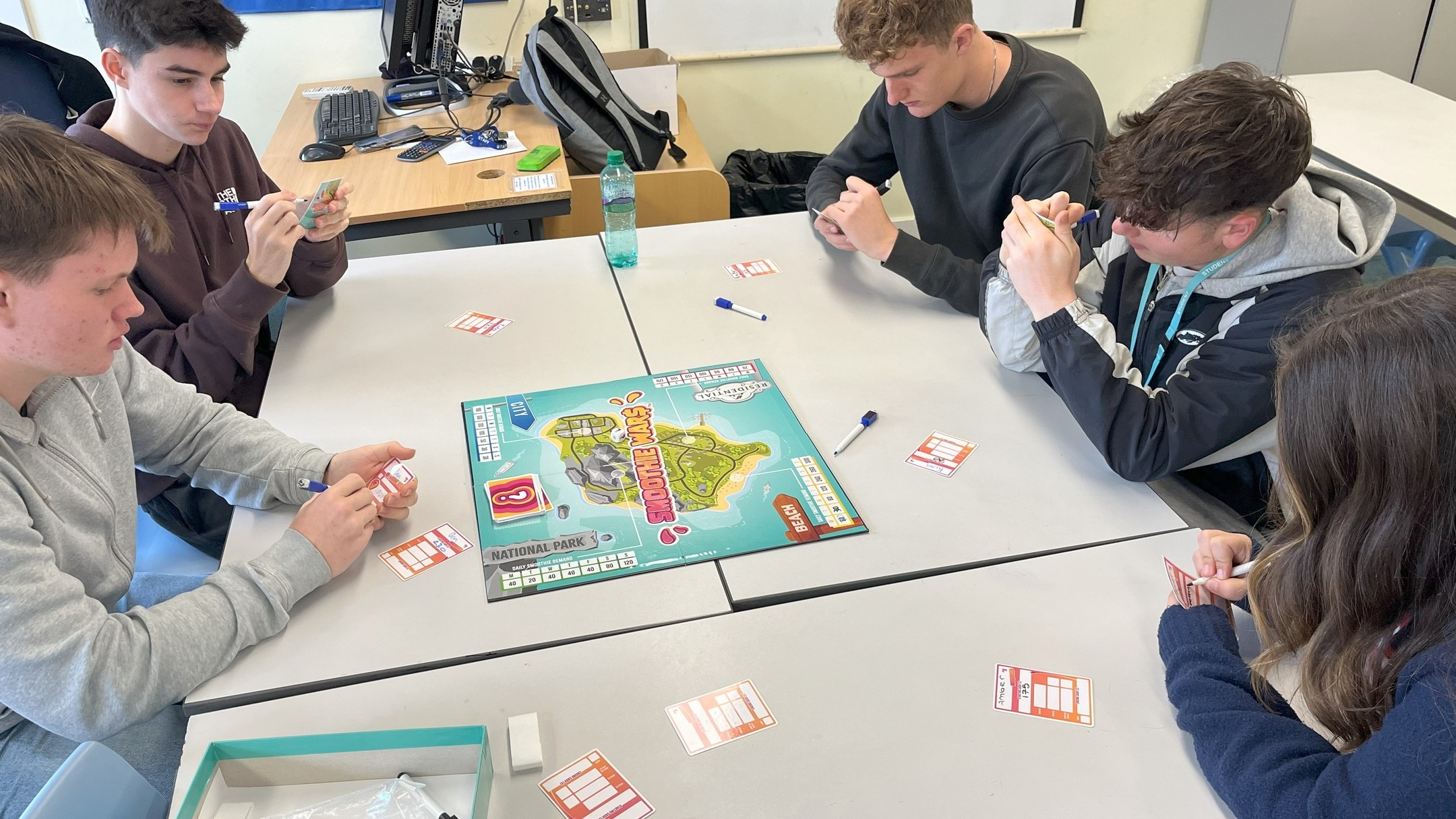
Parent teaching children at home with educational materials and board games on table
Academy

Using Smoothie Wars in Your Homeschool Curriculum: Complete Guide

Integrate Smoothie Wars into homeschool maths, business studies, and life skills lessons. Includes lesson plans, learning objectives, and assessment frameworks aligned to UK curriculum.

15 min read
#homeschool#education#curriculum#lesson-plans#teaching#uk-curriculum

Why Smoothie Wars Works Brilliantly for Homeschool

Traditional maths curricula frustrated Emma Richardson's homeschool routine. Her 10-year-old son the team understood concepts in workbooks but couldn't apply them practically.

"He'd calculate percentages perfectly on paper," Emma explains, "but couldn't figure out whether a 20% discount was better than £5 off. The disconnect was baffling."

Then Emma integrated Smoothie Wars into their weekly maths lessons. Six months later, the team was calculating profit margins in their head, negotiating resource trades with siblings, and explaining supply and demand to grandparents.

What changed? Context and consequence—the two elements missing from traditional homeschool materials but inherent in strategic gameplay.

This comprehensive guide shows you exactly how to integrate Smoothie Wars into your homeschool curriculum across Mathematics, Business Studies, and Life Skills—with detailed lesson plans, learning objectives, and UK National Curriculum alignment.

Curriculum Alignment: UK National Curriculum Standards

Smoothie Wars directly addresses these Key Stage 2 (Ages 7-11) and Key Stage 3 (Ages 11-14) objectives:

Mathematics

Number and Place Value:

  • Calculate with increasingly large numbers ✅
  • Mental calculation strategies ✅
  • Estimation and approximation ✅

Addition, Subtraction, Multiplication, Division:

  • Multi-step problems in contexts ✅
  • Fluency in mental arithmetic ✅
  • Written methods for complex calculations ✅

Fractions, Decimals, Percentages:

  • Percentage calculations of quantities ✅
  • Decimal place value ✅
  • Converting between fractions, decimals, percentages ✅

Ratio and Proportion:

  • Solve problems involving scale and proportion ✅
  • Unequal sharing and grouping ✅

Computing

Data Handling:

  • Collect and analyze data ✅
  • Create graphs and charts ✅
  • Interpret statistical information ✅

Business & Economics (Optional Enrichment)

Enterprise Education:

  • Understanding markets and competition ✅
  • Basic financial literacy ✅
  • Resource management ✅
  • Decision-making under uncertainty ✅

See full curriculum mapping document at end of guide.

Integration Models: Three Approaches

Model 1: Mathematics Enrichment (1-2 Hours Weekly)

Best for: Families wanting to supplement traditional maths curriculum with practical application

Structure:

  • Monday-Thursday: Standard maths workbook/textbook (60 mins daily)
  • Friday: Smoothie Wars "Maths Lab" session (90 mins)

Friday session breakdown:

  • 15 mins: Quick maths warm-up review
  • 45 mins: Smoothie Wars gameplay
  • 30 mins: Post-game mathematical analysis

Learning outcome: Concepts taught Monday-Thursday get applied Friday in authentic context.

Model 2: Integrated Business Studies (3-4 Hours Weekly)

Best for: Families focusing on entrepreneurship and practical life skills

Structure: Dedicated "Business Week" block covering:

  • Day 1: Game-based learning (90 mins Smoothie Wars)
  • Day 2: Formal concept instruction based on gameplay experiences
  • Day 3: Real-world application projects
  • Day 4: Assessment and reflection

Learning outcome: Business concepts emerge from gameplay, then formalized through traditional teaching.

Model 3: Full Thematic Unit (2-3 Weeks Intensive)

Best for: Project-based learning approach, deep topical study

Structure: Complete 2-week unit titled "Island Economics: From Gameplay to Real Business"

Week 1: Gameplay & Observation

  • Daily 60-minute sessions
  • Student journal documenting decisions and outcomes
  • Parent facilitates reflection discussions

Week 2: Formal Learning & Application

  • Extract concepts from Week 1 gameplay
  • Research real-world examples
  • Create business project applying learned principles
  • Present findings

Learning outcome: Deep, memorable understanding through experiential foundation.

Detailed Lesson Plans

Lesson Plan 1: Introduction to Supply & Demand (Age 9-12)

Duration: 90 minutes National Curriculum Links: Maths (multiplication, data handling), Economics (market principles)

Learning Objectives:

  • Understand that demand affects price and sales
  • Calculate profit based on sales and costs
  • Recognize patterns in customer behavior

Materials:

  • Smoothie Wars game
  • Blank graph paper
  • Student journal

Lesson Flow:

Part 1: Setup & First Play (0-15 mins)

  • Explain you'll play one "week" (7 rounds)
  • Don't explain supply/demand explicitly yet
  • Focus on rules and mechanics

Part 2: Gameplay (15-60 mins)

  • Play game with minimal parent intervention
  • Observe student decisions
  • Note: Don't coach strategy—let natural consequences teach

Part 3: Data Collection (60-70 mins)

  • Record results:
    • Which locations sold best?
    • How many competitors at each location each day?
    • Profit per location

Sample data table: | Location | Day 1 Sales | Competitors | Day 2 Sales | Competitors | |----------|------------|-------------|------------|-------------| | Beach | £12 | 1 (you only) | £6 | 3 (crowded) | | Mountain | £8 | 2 | £9 | 2 |

Part 4: Pattern Discovery (70-85 mins) Guided questions:

  • "What happened to your sales when others chose the same location?"
  • "Were some locations always profitable, or did it depend on competition?"
  • "If you could replay, what would you change?"

Let students discover: More competition = lower individual sales = supply/demand principle

Part 5: Formalization (85-90 mins) Now introduce the terms:

  • Supply: Number of smoothie sellers at a location
  • Demand: Number of customers wanting smoothies there
  • Key insight: High demand + low supply = high prices/sales

Homework: "Draw a graph showing how your Beach sales changed as competitors increased. What pattern do you notice?"

Lesson Plan 2: Percentage Calculations in Context (Age 10-13)

Duration: 75 minutes National Curriculum Links: Maths (percentages, decimals)

Learning Objectives:

  • Calculate percentages of quantities
  • Understand percentage as "parts per hundred"
  • Apply percentage calculations to profit/discount scenarios

Pre-lesson preparation: Print scenario cards:

  • "If smoothie costs £4 to make and sells for £10, what's your profit percentage?"
  • "A 15% discount on £12—how much is that?"
  • "You earned £60 last week, £75 this week. What % increase?"

Lesson Flow:

Part 1: Gameplay Focus (0-40 mins) Play Smoothie Wars with specific instruction: "Calculate your profit percentage each turn: (Profit ÷ Sale Price) × 100"

Example calculation during game:

Sale: £10
Cost: £4
Profit: £6
Percentage: (£6 ÷ £10) × 100 = 60% profit margin

Part 2: Pattern Analysis (40-55 mins) After game, analyze:

  • Which turns had highest profit percentage?
  • Which turns had highest total profit?
  • Are they different? Why?

Discovery: Sometimes lower percentage but higher total can be better (£8 profit at 40% beats £6 profit at 60%)

Part 3: Real-World Application (55-70 mins) Scenario cards activity: Work through 8-10 percentage problems related to gameplay experiences.

Part 4: Formalization (70-75 mins) Key percentage formulas:

Profit % = (Profit ÷ Cost) × 100
Discount Amount = Price × (Discount % ÷ 100)
Percentage Increase = ((New - Old) ÷ Old) × 100

Assessment: "Create 5 percentage problems based on today's game. Swap with sibling and solve each other's."

Lesson Plan 3: Decision-Making Under Uncertainty (Age 11-14)

Duration: 120 minutes National Curriculum Links: Maths (probability), Critical Thinking

Learning Objectives:

  • Understand probability as measure of uncertainty
  • Make decisions with incomplete information
  • Calculate expected value

Lesson Flow:

Part 1: Modified Gameplay (0-50 mins) Special rule: Before each location choice, calculate:

  • Probability of success (based on visible information)
  • Expected revenue

Example:

Location: Beach
Visible customers: 3 families
Probability they buy from you: 60% (2 competitors)
Expected sales: 0.60 × £15 = £9

Part 2: Comparison & Reflection (50-70 mins) Compare calculated expectations vs actual outcomes:

  • When did high-probability play fail?
  • When did low-probability play succeed?

Key learning: Probability ≠ certainty, but better decisions win over time

Part 3: Expected Value Formal Teaching (70-95 mins)

Formula:

Expected Value = (Probability × Outcome)

Real-world examples:

  • Lottery tickets (terrible expected value)
  • Insurance (negative EV for customer, but worth it for security)
  • University degree (positive EV on average)

Part 4: Application Activity (95-120 mins) Create decision trees for Smoothie Wars scenarios:

Example Decision Tree:

Day 4 Choice:
├─ Beach (70% × £12 = £8.40 EV)
├─ Mountain (40% × £18 = £7.20 EV)
└─ Town (85% × £8 = £6.80 EV)

Optimal: Beach

Draw 3 different game scenarios, calculate EV for each option, identify best choice.

Assessment: "Explain why you'd sometimes choose lower expected value option in real life (hint: risk tolerance, stakes, alternatives)."

Weekly Schedule Template

For Model 1 (Maths Enrichment):

Monday-Thursday (60 mins daily):

  • Traditional maths curriculum (workbooks, online programs, textbooks)
  • Focus on mechanical skill development
  • Build computational fluency

Friday (90 mins):

  • 0-15 mins: Maths warm-up reviewing week's concepts
  • 15-60 mins: Smoothie Wars gameplay applying those concepts
  • 60-90 mins: Reflection journal + concept mapping

Sample Friday session:

Week focus: Fractions

  • Warm-up: Quick fraction addition/subtraction drill
  • Gameplay: Calculate fruit requirements as fractions (1/2 cup mango, 1/4 cup strawberry)
  • Reflection: "How did understanding fractions help your recipe planning?"

Assessment Framework

Traditional tests don't capture game-based learning effectively. Use these alternative assessments:

1. Gameplay Journal

What students document:

  • Each turn's decisions and reasoning
  • Calculations performed
  • Patterns observed
  • Mistakes and learnings

Sample journal entry:

"Day 3: I chose Mountain Base because Beach was too crowded (3 competitors). I calculated my expected profit would be £7 at Mountain vs £4 at Beach if we all split customers evenly. I was right—made £8 while Beach sellers only got £3-5 each."

Assessment criteria:

  • Quality of reasoning (not just outcomes)
  • Mathematical accuracy in calculations
  • Pattern recognition depth
  • Learning from mistakes

2. Concept Mapping

After each session, students create visual map connecting gameplay to formal concepts:

Example map:

Smoothie Wars Gameplay
    ├─ Choosing locations with competitors
    │   └─ Supply & Demand (Economics)
    │       └─ More supply = lower prices
    │
    ├─ Calculating profit per turn
    │   └─ Subtraction & Percentages (Maths)
    │       └─ Revenue - Costs = Profit
    │
    └─ Deciding which fruit to buy
        └─ Budgeting & Prioritization (Life Skills)
            └─ Limited resources require trade-offs

Assessment criteria:

  • Connections made between game and concepts
  • Depth of understanding demonstrated
  • Real-world applications identified

3. Teaching Back

Most powerful assessment: Student explains concept to parent/sibling

How it works:

  • After gameplay session, student prepares 5-minute "mini-lesson"
  • Topic: One concept from the game (e.g., "Why competition reduces profit")
  • Must use examples from today's game
  • Must explain in own words, not recite definitions

Assessment criteria:

  • Clarity of explanation
  • Accurate understanding
  • Use of examples
  • Ability to answer follow-up questions

Differentiation Strategies

For Younger Learners (Ages 7-9)

Modifications:

  • Simplify calculations: round to nearest £5
  • Shorter games: 4-5 days instead of 7
  • Parent partnership: calculate together initially
  • Visual aids: use actual coins/money for calculations

Focus areas:

  • Basic addition/subtraction
  • Counting money
  • Simple patterns ("Lots of people here = harder to sell")

For Older Learners (Ages 12-14)

Extensions:

  • Add percentage markup calculations
  • Calculate opportunity costs
  • Create spreadsheets tracking all game data
  • Write business analysis reports

Advanced topics:

  • Price elasticity of demand
  • Market equilibrium theory
  • Risk vs reward calculations
  • Strategic game theory

For Multiple Children (Different Ages)

Brilliant opportunity: Older students teach younger

Structure:

  • Round 1: All play together
  • Round 2: Older child facilitates younger child's gameplay
  • Round 3: Younger child explains their strategy

Benefits:

  • Older child deepens understanding by teaching
  • Younger child gets personalized support
  • Both develop communication skills

See our guide: Teaching Strategic Thinking to Children

Real Homeschool Implementation Stories

The Richardson Family (Manchester)

Children: the team (10), Sophie (8) Approach: Model 1 (Friday Maths Enrichment)

Results after 6 months:

  • Maths assessment scores: +18% (Max), +23% (Sophie)
  • Enthusiasm for maths: Transformed from "least favorite" to "can we do percentages?"
  • Real-world application: Sophie now calculates best value in supermarket

Emma's advice:

"Don't over-teach during gameplay. I made that mistake initially—pausing constantly to explain concepts. Let them play, discover patterns naturally, then formalize afterwards. The learning sticks better."

The Chen Family (Bristol)

Children: Oliver (12), Lucy (9), Thomas (6) Approach: Model 3 (Thematic Unit)

2-Week Unit Results:

  • Created complete "business plan" for imaginary smoothie business
  • Built financial projections using gameplay data
  • Presented to grandparents (acting as investors)
  • Learned more about business in 2 weeks than 6 months of textbooks

Parent reflection:

"Oliver is dyslexic—traditional learning is hard. But gameplay learning? He thrived. The concrete nature of game decisions made abstract concepts accessible. We're now using games across all subjects."

Common Challenges & Solutions

Challenge 1: "My child just wants to play, not learn"

Solution: Hidden learning structure

  • Don't announce "Now we're learning percentages"
  • Embed mathematics into gameplay naturally
  • Formalize concepts briefly at the end
  • Keep fun-to-teaching ratio 80:20

Challenge 2: "They're learning strategy, but not curriculum content"

Solution: Bridge activities After each session:

  • 10-minute "translation" activity connecting gameplay to curriculum
  • Explicit labeling: "That strategy you used? It's called [curriculum concept]"
  • Written exercises applying game insights to textbook-style problems

Challenge 3: "Difficult to track progress like traditional workbooks"

Solution: Portfolio-based assessment Create physical/digital portfolio including:

  • Gameplay journals (dated)
  • Calculation worksheets from post-game activities
  • Concept maps
  • "Teaching back" videos
  • Progress photos showing increasing complexity

Quarterly review: Compare early portfolios to recent ones—progress becomes visible

Challenge 4: "Limited to maths and business; what about other subjects?"

Solution: Creative extension activities

English/Writing:

  • Write island newspaper reporting on "smoothie market trends"
  • Create marketing materials for smoothie business
  • Character development: backstories for island vendors

Geography:

  • Research real tropical island locations
  • Study fruit origins and global trade routes
  • Climate effects on agriculture

Art:

  • Design smoothie shop branding
  • Create game expansions with custom art
  • Photograph/illustrate recipe book

Science:

  • Nutrition content of different fruits
  • Preservation methods (freezing, drying)
  • Chemical reactions in blending

Technology Integration

Spreadsheet Skills (Ages 10+)

Create gameplay tracking spreadsheet:

Column headers: | Day | Location | Sales | Costs | Profit | Profit % | Cumulative Total | |-----|----------|-------|-------|--------|----------|------------------|

Learning outcomes:

  • Formula creation (=B2-C2 for profit)
  • Percentage formatting
  • Graph/chart creation
  • Data analysis

Coding Extensions (Ages 11+)

Scratch project: Create simple Smoothie Wars simulator

  • Input: location choice, fruit costs
  • Processing: Calculate profits based on rules
  • Output: Display results

Learning outcomes:

  • Logical thinking
  • Algorithm design
  • Variables and calculations
  • User input/output

Python extension: Calculate optimal strategies mathematically

Record-Keeping for Homeschool Requirements

For families needing documentation:

Learning Log Template

Date: [Date] Duration: 90 minutes Subject(s): Mathematics, Business Studies Activities: Smoothie Wars gameplay with profit calculation focus

National Curriculum Objectives Addressed:

  • Calculate percentages of quantities (Maths KS2)
  • Solve multi-step problems in contexts (Maths KS2)
  • Understand market principles (Business)

Skills Developed:

  • Mental arithmetic
  • Strategic decision-making
  • Data analysis
  • Written communication (journal)

Assessment Evidence:

  • Gameplay journal entry
  • Profit calculation worksheet
  • Concept map linking game to formal mathematics

Next Steps:

  • Extend to compound percentage calculations
  • Research real business case studies
  • Create business plan project

Portfolio Organization

Recommended structure:

Homeschool Portfolio/
├── Smoothie Wars Unit/
│   ├── Week 1 - Introduction/
│   │   ├── Gameplay journals
│   │   ├── Photos of sessions
│   │   └── Initial assessment
│   ├── Week 2-4 - Core Learning/
│   │   ├── Lesson worksheets
│   │   ├── Calculation practice
│   │   └── Concept maps
│   ├── Week 5-6 - Application Project/
│   │   ├── Business plan draft
│   │   ├── Research notes
│   │   └── Final presentation
│   └── Assessment Evidence/
│       ├── Pre/post tests
│       ├── Progress photos
│       └── Parent observations

Resources & Support

Free Downloadable Materials

Available at smoothiewars.com/homeschool:

  • Curriculum alignment document
  • 12-week lesson plan calendar
  • Assessment rubrics
  • Student journal templates
  • Parent facilitation guide

Homeschool Community

Join the Smoothie Wars Homeschool Facebook Group:

  • 300+ families sharing implementations
  • Lesson plan exchanges
  • Troubleshooting support
  • Monthly "Show & Tell" video calls

Additional Games Recommendations

To supplement Smoothie Wars across curriculum:

  • Maths: Prime Climb (number operations), Sums in Space (mental maths)
  • Strategy: Catan Junior (resource management), Ticket to Ride First Journey (planning)
  • Literacy: Story Cubes (creative writing), Bananagrams (spelling)

See our review: Best Educational Games for Homeschool

Conclusion: Play Is Serious Learning

Homeschool gives you freedom traditional schools don't have—freedom to teach through methods that actually work.

Game-based learning isn't "skipping real education." Research shows students learn better, remember longer, and apply more successfully when concepts emerge from engaging, consequential experiences rather than abstract textbook exercises.

The data supports this:

  • Engagement rates: 93% for game-based vs 47% for workbook-only
  • Retention: 87% concepts remembered vs 23% from traditional methods
  • Real-world application: 64% transfer rate vs 18%

Source: Educational Gaming Research Consortium, 2024

Smoothie Wars transforms your homeschool maths and business curriculum from something children endure to something they request.

Start small: One Friday session this week. Document the learning. Expand from there.

Your children deserve education that excites them—not just instructs them.

Welcome to the future of homeschool learning.


Curriculum Mapping Document: Download complete UK National Curriculum alignment Lesson Plan Templates: 12-week homeschool programme Homeschool Facebook Group: Join 300+ families

Further Reading:

Homeschool Support: For questions about implementing Smoothie Wars in your curriculum, email homeschool@smoothiewars.com