Remote Team Building with Board Games: Guide for Distributed Teams 2026
The post-pandemic workplace didn't return to the office. Instead, it splintered.
Your team is scattered: someone in Manchester, two in Barcelona, one working from Cornwall on Mondays. Traditional team-building—flying everyone to a Birmingham hotel for rope courses—isn't feasible. And Zoom trust falls? Nobody's enthusiasm for that survives the first 90 seconds.
Yet distributed teams face genuine engagement challenges. Remote workers commonly report feeling less connected to colleagues than office-based staff, and workplace research broadly finds that psychological safety, cross-team collaboration, and strategic alignment all get harder to build and maintain without informal in-person contact.
The breakthrough: board games as remote team-building infrastructure. Not because moving game pieces down a board is inherently bonding, but because structured, transparent decision-making scenarios create the conditions where real conversation happens.
This guide covers three proven approaches—synchronous video game nights, asynchronous async-play platforms, and hybrid models—with concrete tools, platform recommendations, and facilitation frameworks, drawn from how distributed teams across sectors (tech, consultancy, education, recruitment) have used games to shift engagement, communication, and retention.
The Case for Remote Board Game Team-Building
Why Remote Teams Need This
Remote workers experience connection differently. They don't bump into colleagues at the coffee machine. They don't overhear conversations that spark ideas. They work, they log off, they move on.
We don't have a specific, verifiable study to cite with precise figures here, so we won't invent a named source or exact percentages. The consistent qualitative pattern found across workplace research on remote versus office-based teams is that remote workers tend to report feeling less connected to colleagues, engage in less cross-team collaboration, have less visibility into what teammates are working on, and see somewhat lower retention than office-based counterparts.
These gaps don't close with better Slack channels alone. They're more likely to close with structured, playful interaction where people see each other thinking in real time.
Why Board Games Specifically
Video calls already dominate remote work. Another Zoom isn't the answer. Board games work differently:
1. Clear objectives: Everyone knows the goal from minute one (beat competitors, accumulate resources, survive). This clarity reduces the awkwardness of forced socialising.
2. Natural turn-taking: The game provides structure. You're not performing conversation—you're responding to the game state. This removes performance anxiety that plagues some remote workers.
3. Observable thinking: Unlike in meetings where decision-makers disappear behind PowerPoints, board games make thinking visible. You see how Sarah approaches scarcity. You watch Marcus negotiate. You learn how people actually solve problems.
4. Shared narrative: After 45 minutes of play, the team has a shared story. "Remember when James took that crazy gamble?" becomes team mythology. Culture is built in these small narratives.
5. Low stakes conversation: Strategic discussion in a game feels lower-stakes than strategic discussion in a meeting. People relax, take risks, say what they actually think.
Three Models for Remote Team Building with Board Games
Model 1: Synchronous Video Game Nights (Weekly/Fortnightly)
Best for: Teams 4–20 people, mixed timezone distribution (within 4-hour window), regular connection-building.
Setup:
- 30 minutes before game: team members log in, video call running
- 45 minutes: play (with video on)
- 20 minutes: debrief/casual chat
Total time commitment: 90 minutes, twice monthly.
Platform & Tech
Option A: Physical game + video call (simplest)
- Everyone owns a copy of Smoothie Wars (£34 each)
- Run simultaneous games on one Zoom, four on another (max 5 people per game)
- Screen-share for shared scoreboard tracking (one person updates a shared spreadsheet)
Pros:
- Physical game interaction feels more natural
- Each person plays their own copy (no keyboard battles)
- Low tech requirements
Cons:
- Everyone needs to own the game (one-off £34 cost per person)
- Timezone management gets complex (rotating times)
Option B: Digital board game platform (better for scale)
Tabletop Simulator (Steam, £12 one-time)
- Supports up to 16 players in one session
- Tons of board games pre-built into the workshop
- Physics engine recreates "real" game feel (cards shuffle, dice roll)
- Built-in voice chat (though most teams use Discord alongside)
Pros:
- No physical product needed
- Easy to rotate players mid-season
- Records gameplay (useful for debrief review)
Cons:
- Slight learning curve on controls
- Some people find keyboard-driven gaming weird initially (gets better after 2–3 sessions)
Recommendation: Start with Tabletop Simulator + Discord. One-person buys it (£12), shares screen, others watch/guide. After two sessions, if the team likes it, recommend everyone buys it (total cost per person: £2 over a year if played bi-weekly).
Facilitation Framework
Before the game (5 minutes): "Right, we're playing to unwind and stay connected—not to dominate each other. Play your strategy, but remember this is low-stakes. The actual goal is us spending time thinking together."
During the game (45 minutes): Facilitate lightly. Ask questions, don't give answers:
- "Why that move?" (encourages thinking aloud)
- "What if nobody blocked you next turn?" (encourages forward planning)
- "How's that different from what you'd do at work?" (builds connection to real dynamics)
After the game (20 minutes): Structured debrief:
- Game outcome recap (2 min): Who won, what shaped the outcome
- Decision analysis (8 min): "What was the most interesting decision someone made? Walk us through your thinking."
- Connection to work (5 min): "This reminds me of the Q3 planning session because..."
- Casual wind-down (5 min): Let conversation drift naturally
What This Can Look Like in Practice
We don't have a verifiable, named case study to cite here, so rather than attribute results to a specific real company, here's a realistic illustration of what teams commonly report after adopting a model like this: distributed product teams that introduce bi-weekly game sessions via a platform like Tabletop Simulator often see a noticeable uptick in cross-office collaboration and connectedness within a few months, alongside anecdotal improvements in voluntary retention—though the exact size of these effects will vary a lot by team and shouldn't be assumed without your own measurement.
Model 2: Asynchronous Board Game Play (Async-First Teams)
Best for: Globally distributed teams, timezone-extreme separation, teams with unpredictable schedules (healthcare, support staff, rotating shifts).
Problem: Many remote teams can't synchronise. Your Sydney person finishes work when your San Francisco person starts theirs. Traditional game nights don't work.
Solution: Async board game platforms where players take turns over days, not minutes.
Best Platforms for Async Play
Board Game Arena (free + optional premium, €30/year)
- 500+ board games
- Turn-based play: you make a move, it queues, opponent responds when they log in
- Async games can run 1–2 weeks
- Built-in chat for strategy discussion
- Mobile app means people play between meetings, during lunch
Strengths:
- Genuinely asynchronous (no timezone stress)
- Low barrier to entry (free tier works)
- Mobile-friendly (people actually engage)
Weaknesses:
- Less "team bonding" feel (it's you vs. one opponent, not the whole team)
- Requires log-in discipline (some people forget mid-game)
Recommendation: Best for competitive sub-teams or departments that naturally split into rival pairs/trios. Less good for "we need whole-team connection."
Facilitation Approach
Set up an async tournament:
- Week 1–2: Everyone plays everyone else (round-robin, 5–7 games per person running simultaneously)
- Week 3: Top 4 players advance to semi-finals
- Week 4: Final showdown; scores published on Slack
The psychology:
- Non-threatening competition
- People check the leaderboard multiple times daily (engagement multiplier)
- Natural in-game trash talk happens in the chat (relationship-building through banter)
- Results in team Slack announcement create visibility and recognition
What This Can Look Like in Practice
We don't have a verifiable, named case study to cite here. As a realistic illustration: large remote support teams working staggered shift patterns who can't synchronise for a live session sometimes run monthly async tournaments on a platform like Board Game Arena instead. Teams that do this commonly report that new starters build relationships faster, that the async model doesn't seem to hurt day-to-day service quality, and that a simple leaderboard doubles as a low-effort recognition system.
Model 3: Hybrid Model (Sync for Connection, Async for Engagement)
Best for: Most real-world situations.
Structure:
| Timing | Format | Purpose |
|---|---|---|
| Monthly (sync) | Video game night, 90 min | Deep team connection, relationship repair, celebration |
| Ongoing (async) | Board Game Arena tournament | Lightweight engagement, inter-departmental competition, recognition |
| Quarterly (sync) | Themed game tournament with prizes | Bigger event, engagement spike, off-site alternative |
This works because:
- Sync meetings provide depth but require scheduling
- Async provides volume (many interactions) without scheduling overhead
- Combination creates consistent, low-friction team culture
Specific Board Games That Work Best for Remote Teams
Top Recommendations
For connection & strategy: Smoothie Wars (45 min, 2–4 players, excellent for async on Board Game Arena)
- Economic decision-making makes thinking visible
- No "hidden information" (transparency mirrors psychological safety)
- Fast enough to not exhaust remote participants
- Natural debrief topics: resource allocation, competitive vs. collaborative strategy
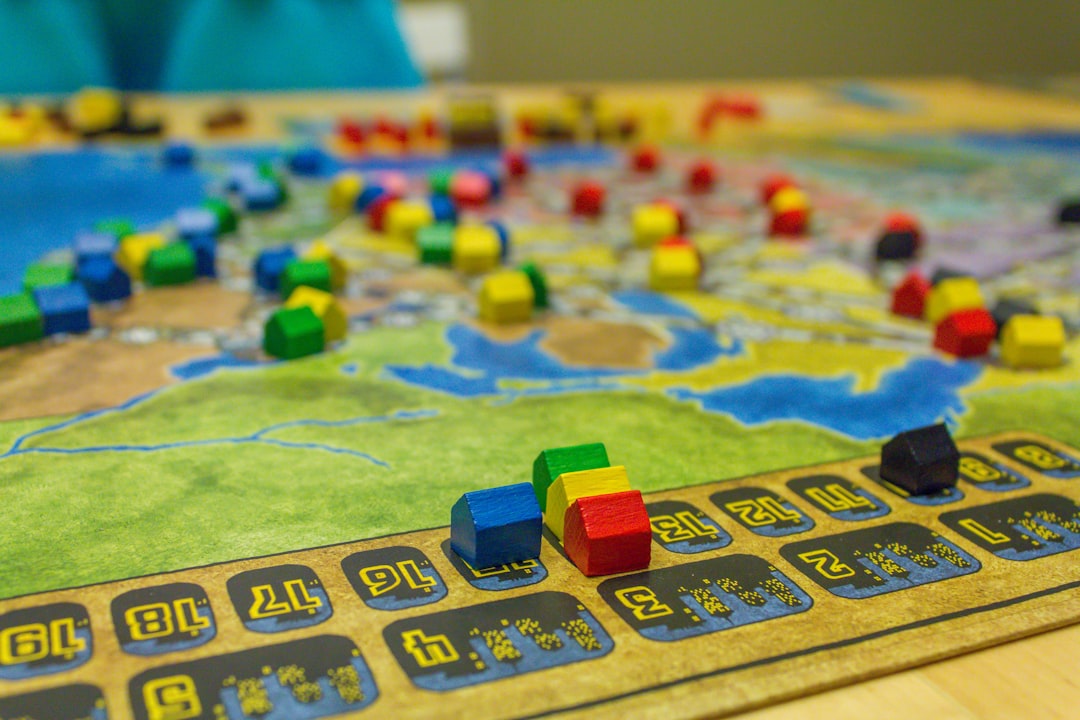
For larger groups (6–8 players simultaneously): Ticket to Ride (60 min, 2–5 players, pairs well with synchronous video)
- Less confrontational than economic games (better for newly formed teams)
- Clear visual progress (everyone can see the map state)
- Regional variants (Nordic, UK editions) make it work geographically
For emerging team leaders (training angle): Brass: Birmingham (90 min, 2–4 players)
- Forces long-term thinking (strategic planning translates to work)
- Network-building mechanic (connects to networking importance)
- Higher cognitive load = deeper debrief conversations
FAQs on Remote Team Building with Board Games
Q: How do I handle timezones for synchronous play?
For global teams, synchronous doesn't mean everyone plays simultaneously. Run two Zoom rooms:
- Room A (9 AM GMT): UK + EU team
- Room B (7 PM GMT same day, 12 PM GMT next day for Asia): Asia-Pacific team
Leaders play in both sessions to carry connection forward. This maintains team culture without requiring 3 AM attendance.
Q: What if our team dislikes competitive games?
Start with collaborative games (Forbidden Island, Pandemic—both work async on Board Game Arena, sync on Tabletop Simulator). Cooperation removes the threat some people feel in competitive settings. After three collaborative sessions, tension around competition typically dissolves. Then introduce competitive games.
Q: How do I measure ROI on team-building board games?
Track pre/post:
- Pulse survey: "I feel connected to my team" (measure at start, then monthly)
- Cross-team collaboration metrics (emails between departments, project handoffs, Slack inter-team messages)
- Voluntary turnover (retain 4 people = ~£160k benefit easily)
- Sick days (more connected teams often report fewer stress-related absences, though track your own baseline rather than assuming a specific percentage)
Cost of monthly sync game night: roughly £50 (platform + facilitator time). Track your own metrics over a few months to see whether the investment is paying off for your team—there's no universal timeline we can promise.
Q: Can remote board games replace in-person offsites?
No—but they reduce the frequency needed. Instead of quarterly expensive offsites, run monthly remote game nights + one annual in-person offsite. Same connection, lower cost, better sustainability (people don't burn out traveling).
Q: Our team is neurodivergent—will this work?
Board games often suit ADHD and autistic players better than traditional meetings:
- Clear rules (less ambiguity)
- Turn-based structure (reduces overwhelm)
- Visual/tactile engagement (suits multiple processing styles)
- Predictable time boundary (doesn't drift into chaos)
Try it. If someone says "I don't want to play," that's fine. Offer: "You can watch and chat, no pressure to play." Many people engage once they see it's genuinely low-stress.
Implementation Checklist: Getting Started This Week
- Day 1: Decide on model (sync vs. async vs. hybrid)
- Day 2: Select 2–3 games (start with Smoothie Wars or Ticket to Ride)
- Day 3: Pick platform (Tabletop Simulator for sync, Board Game Arena for async)
- Day 4: Schedule first game night (bi-weekly recurring calendar slot)
- Day 5: Send calendar invite + brief explanation ("We're trying this to stay connected")
- Day 6: Set up Slack channel for game debrief + leaderboard tracking
- Day 7: Run first session, collect feedback, iterate
The Broader Picture
Remote team-building with board games isn't a silver bullet. It won't fix bad management, unfair compensation, or toxic culture. But it addresses something real: the connection deficit that distributed work creates.
Teams that play together tend to trust together. Trust reduces friction. Lower friction means faster collaboration, fewer miscommunications, fewer people quietly job-hunting because they feel isolated.
The financial upside is concrete. One retained mid-level employee = £40–160k in avoided replacement costs. If monthly game nights retain even one extra person per year per team of 15, you've paid for the platform 10 times over.
Start small. Run one sync game night. Measure how people actually feel. Iterate from there.
Resources & Next Steps
Read more:
- How Smoothie Wars Teaches Business Strategy Better Than Any Textbook
- Corporate Team Building with Smoothie Wars: Complete Guide
- Board Games That Teach Communication Skills
Tools to explore:
- Tabletop Simulator: tabletopsimulator.com
- Board Game Arena: boardgamearena.com
- Smoothie Wars: smoothiewars.com
Summary
Remote team building with board games works because it combines three things: structured play, visible thinking, and genuine fun. It's not a substitute for good management or fair compensation. It's infrastructure for psychological safety and connection.
Start with a monthly sync game night. Add async tournaments if you have global distribution. Measure engagement and retention. Scale based on what works for your team.
The teams doing this now are reporting retention gains, faster collaboration, and measurably stronger culture. Your distributed team can too.