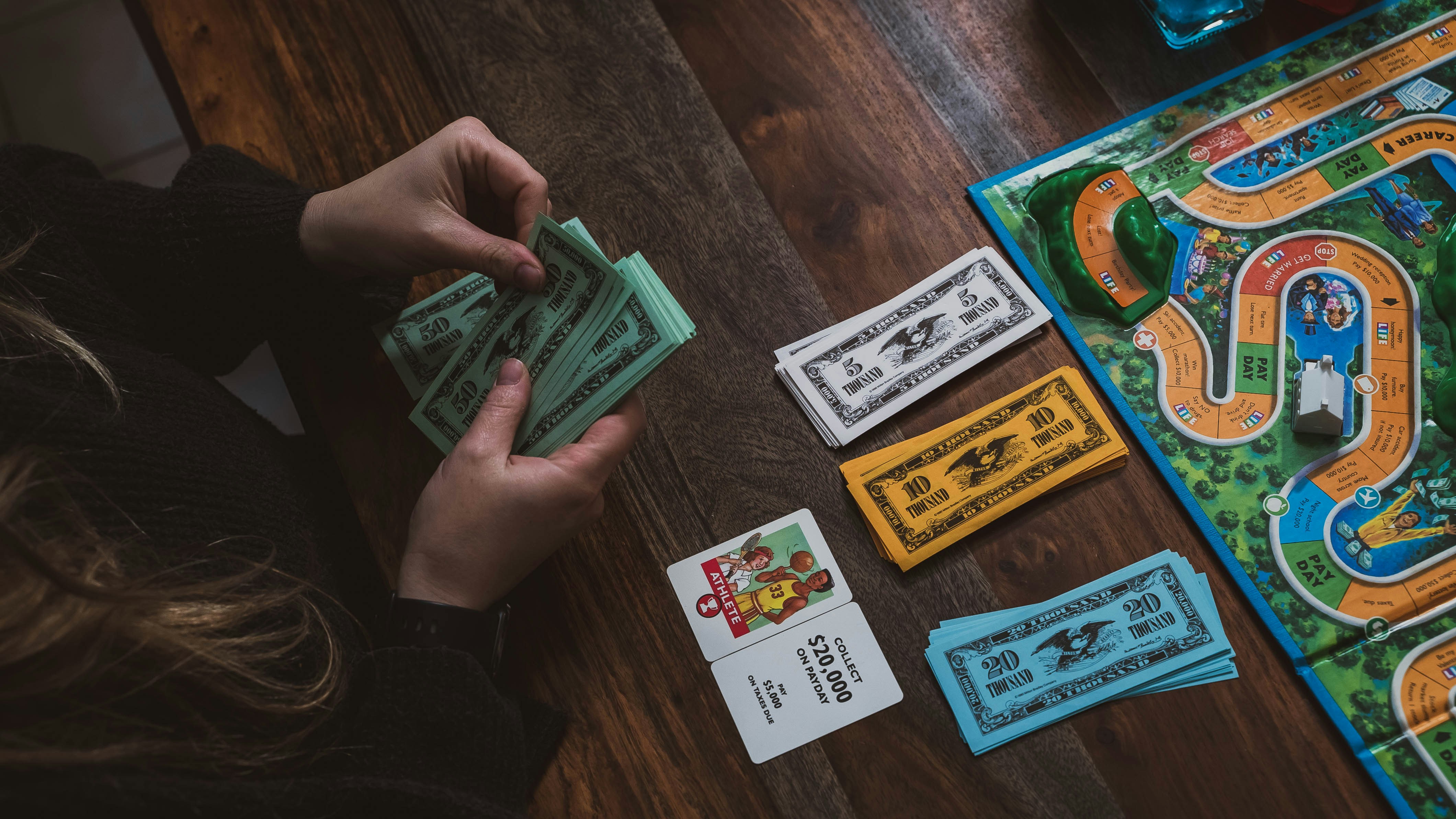
Most children leave school able to recite times tables but unable to explain why a shop marks up its prices, or what happens when it spends more than it earns. I see this gap constantly, both as a doctor talking to parents in clinic and as someone who has spent years designing a game about running a small business. The good news is that board games are one of the most effective, lowest-stakes ways to close that gap. A child who loses a pretend fortune on a Tuesday evening learns more about risk than a lecture ever could, and nobody's rent money was actually at risk.
This guide sets out a practical, step-by-step approach for parents who want to use board games that teach money skills deliberately, rather than by accident. It moves from simple counting games for four-year-olds through to negotiation and cash flow for young teenagers, with a real example from my own family along the way.
TL;DR
- Start money learning early with simple counting and trading games, well before children handle real cash.
- Move through clear stages: counting, resource trading, profit and loss, then risk and negotiation.
- Talk about decisions after the game, not just during it. The debrief is where the learning sticks.
- By age 12+, games with real trade-offs (like Smoothie Wars) build intuition that mirrors real business decisions.
Why board games work for financial literacy
Children learn abstract concepts best when they can touch them. Money is unusually abstract for a young mind: it is a symbol that represents value, which itself represents effort, scarcity and choice. A coin on a board game feels concrete in a way that a bank balance on a screen never will. Games also let children fail safely. If a seven-year-old overspends in Monopoly Junior, the only consequence is losing a round, not missing a meal. That safety is exactly what makes the lesson land.
Children build number sense and money sense in parallel, but money sense needs repeated, low-stakes practice with real trade-offs. A worksheet cannot replicate the feeling of watching your pile of coins shrink because you spent too fast. A game can, and it does it in twenty minutes rather than twenty years.
Step 1: Start with simple counting and trading (ages 4 to 6)
The first stage is not really about money at all. It is about counting, matching and turn-taking, with money-shaped props to make it feel grown-up. Monopoly Junior is the obvious starting point here. The board is simplified, the amounts are small and round, and the core loop of earning, spending and running out is intact without any reading-heavy rules to slow things down.
At this age, the goal is simply familiarity: recognising that different notes and coins have different values, that you can trade a big one for several small ones, and that spending reduces what you have left. Do not expect strategic thinking yet. Expect delighted counting.
What to look for in a game at this stage
- Physical money pieces your child can sort, stack and count.
- A short playtime (fifteen to twenty minutes), because attention spans are short.
- Simple win conditions, so the "why" of the game is never in doubt.
Step 2: Introduce real trade-offs (ages 7 to 9)
Once counting is second nature, children are ready for the idea that resources are limited and choices have costs. This is where trading games earn their keep. Catan, played in its junior form or with a patient adult narrating the trades, introduces the idea that you might have plenty of one resource and none of another, and that a fair trade benefits both sides.
This is a genuinely important cognitive leap. Up to this point, "more is better" has been the only rule a child needs. Trading introduces the idea that value is relative to what you already have and what you need next, which is the seed of every future negotiation they will ever make, from a lemonade stand to a job offer.
Step 3: Bring in profit and loss (ages 10 to 12)
By age ten or eleven, most children can grasp a simple shop simulation: buy stock at one price, sell it at another, and keep the difference. You do not need a licensed game for this. A pretend market stall, built from a shoebox and a handful of toy fruit, works just as well, and several family-friendly games (including simplified versions of Payday or a homemade "market day" game) formalise the same idea.
The concept to land here is margin: the gap between what something costs you and what you can sell it for. Ask your child, after each round, what they paid, what they charged, and what was left over. That question, repeated across a dozen games, builds an intuition that most adults only pick up by accident in their twenties.
😤 Situation: Your child sells all their stock in one turn at a low price, then has nothing left to sell for the rest of the game
Effective response: Ask them what would have happened if they had held back half their stock and sold it later at a higher price. Do not tell them the answer. Let the next game be the answer.
Step 4: Add risk, competition and negotiation (ages 12+)
This is the stage where Smoothie Wars fits naturally. By twelve, children can handle genuine uncertainty: prices that move because of what other players do, locations that become less profitable once a rival sets up nearby, and the discomfort of watching a competitor undercut you. These are not abstract business school concepts. They are the same pressures that shape every real market, from a market town's high street to a global supply chain.
In Smoothie Wars, three to eight players run smoothie stalls across a tropical island over the course of a pretend week. Each day brings decisions about where to sell, how to price, and when to hold back rather than chase every sale. It was built specifically to sit at this age and stage: complex enough to be interesting for an adult, but transparent enough that a twelve-year-old can trace exactly why they won or lost.
♟️ Strategy: Reading the market before you commit
The strongest players in Smoothie Wars, of any age, are the ones who watch what everyone else is doing before they lock in a location for the day. That single habit, pausing to read the situation instead of reacting on instinct, transfers directly to real financial decisions later in life.
Here is a moment from testing Smoothie Wars with my own children that stuck with me. My eleven-year-old had priced her smoothies far below everyone else's, convinced that cheap meant more sales. She sold out fast and looked triumphant, right up until she counted her takings and realised she had made less money than her brother, who had sold half as many smoothies at nearly double the price. She sat with that number for a long moment. Nobody explained margin to her. The game did it, and she has not forgotten it since.
Step 5: Talk it through afterwards, every time
The single biggest difference between a game that entertains and a game that teaches is the conversation that happens after the box is packed away. Children absorb far more from being asked to explain their own decisions than from being told the right answer mid-game, when they are still emotionally invested in winning.
Three questions work well after almost any money-themed game:
- What was your best decision this game, and why did it work?
- What would you do differently if you played again tomorrow?
- Did anyone else's strategy surprise you?
📊 Research: Repeated low-stakes financial decision-making in children
This lines up with a broader, well-established idea in learning science: children who are asked to reflect verbally on a decision tend to retain the underlying concept better than those who simply repeat the activity without discussion. We haven't traced this specific claim to a single citable study, so treat it as a general principle rather than a precise, checkable finding.
Source: General pattern in learning science on reflection and retention
Matching games to age and money concept
A rough guide to which money concepts suit which age range
| Age range | Core money concept | Example games |
|---|---|---|
| 4 to 6 | Counting, recognising value | Monopoly Junior, simple shop role-play |
| 7 to 9 | Trading, relative value | Catan Junior, card-trading games |
| 10 to 12 | Profit and margin | Market stall role-play, Payday |
| 12 to 15 | Risk, competition, negotiation | Smoothie Wars, Catan |
| 16+ | Cash flow, long-term strategy | Smoothie Wars, Monopoly, investment-themed games |
🔑 Key Takeaways
- ✓Money skills build in stages, from counting through trading to profit, risk and negotiation.
- ✓Physical games make abstract concepts concrete, which is exactly why they work better than lectures.
- ✓The post-game conversation matters as much as the game itself.
- ✓By age 12+, games with genuine trade-offs and competition, like Smoothie Wars, do the heaviest lifting.
Frequently asked questions
What age should kids start learning about money?
Most educators suggest starting as young as four or five with simple counting and matching, well before children handle real cash unsupervised. The MoneyHelper service, a UK government-backed guidance body, recommends introducing basic money concepts through play from an early age, gradually adding complexity as a child's number sense develops.
Do board games really teach financial literacy?
They teach the intuitions that sit underneath financial literacy: that resources are limited, that trade-offs have consequences, and that patience often beats impulse. They are not a substitute for formal guidance on saving, budgeting or debt, but they build the instincts that make that later guidance easier to absorb. The UK government's own resources at GOV.UK on financial education for schools note that experiential, repeated practice outperforms one-off lessons.
Is Smoothie Wars appropriate for younger children?
Smoothie Wars is designed for ages twelve and up, because it deliberately introduces competitive pricing and negotiation that younger children usually find frustrating rather than fun. For children under twelve, the earlier stages above (counting, trading, simple profit games) are a better fit, with Smoothie Wars as the natural next step once they are ready for it.
How long does it take to see the benefit?
Do not expect a single game to change how your child thinks about money. The benefit comes from repetition across months, ideally with a short conversation after each session. Families who play a money-themed game roughly once a fortnight tend to see their children start applying the concepts unprompted, in comments about pocket money or shop prices, within two to three months.
Where to go from here
If your children are still in the counting and trading stages, stick with the simpler games above and be patient. But if you have a twelve-year-old (or a houseful of mixed ages, which is common) who is ready for real competition, negotiation and the occasional hard lesson about pricing, Smoothie Wars was built for exactly that moment. It is a deliberate step up from Monopoly and Catan, designed by someone who spends his working life thinking about both medicine and money, and it turns a Saturday evening into the kind of financial education no worksheet can match.