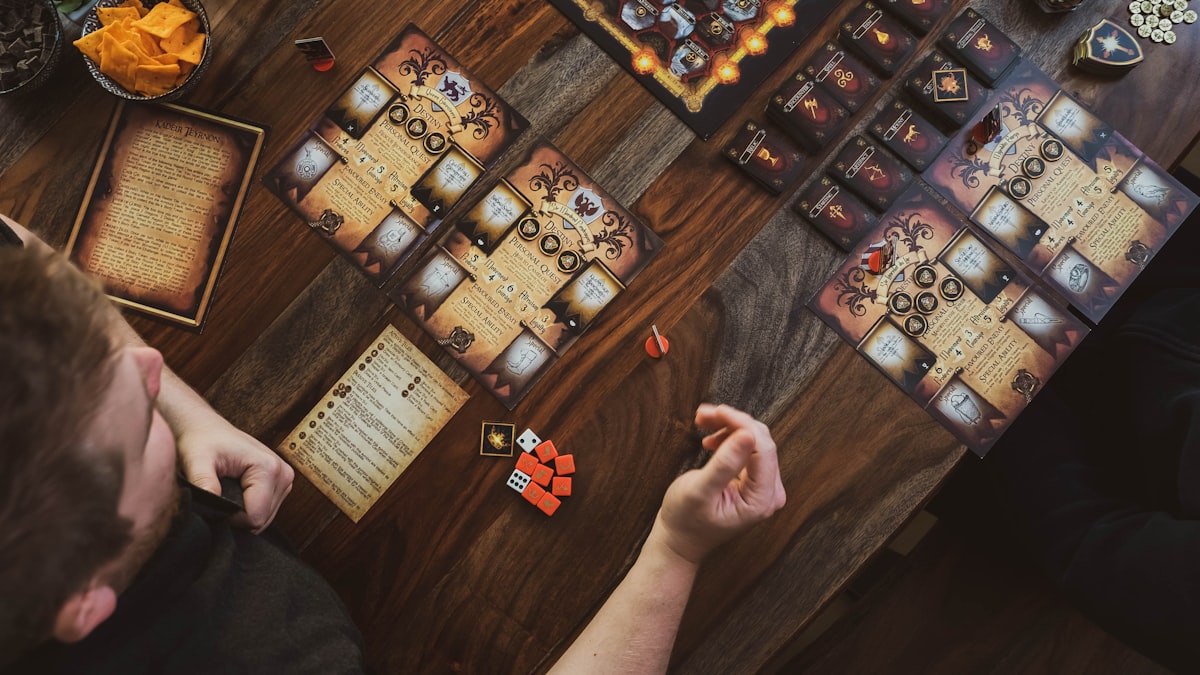
A few years ago, I would mention that I was designing a board game and get a polite, slightly confused nod, as if I had said I was still making cassette tapes. Nobody says that anymore. Ask around now and most people have a game night, a shelf of boxes, or at least a favourite they play at Christmas. Something has genuinely shifted in how we spend our evenings, and it is worth understanding why, because it changes what a good new board game in 2026 actually needs to offer.
TL;DR
- Tabletop gaming has grown steadily for over a decade, not overnight, so this is a durable shift rather than a fad
- Screen fatigue is pushing people toward activities with a clear start and end, and a table full of real faces
- Crowdfunding platforms have let small, independent designers reach players directly, without needing a big publisher first
- Board game cafes and social "third places" are giving the hobby a home outside the living room
We are tired of screens, even the fun ones
I do not think anyone is anti-screen. I write this on one, and most of us relax with one most evenings. But there is a difference between choosing to watch something and feeling like you never really left work mode. A shared screen, watched in silence, is not the same kind of togetherness as a table where everyone is leaning in, arguing about a trade, and laughing at someone's terrible decision.
Board games offer something screens generally cannot: a defined session with a beginning, middle and end, played face to face, where everyone's phone stays in a pocket. That structure matters more than people expect. A round of a good strategic game gives you an hour where the only notification you get is someone stealing your best location on the board.
Crowdfunding gave small designers a route to market
This is the part of the boom that I think gets underestimated. Twenty years ago, if you designed a game in your spare room, your only path to shelves was convincing a publisher to take a punt on you, which is a slow and uncertain business. Crowdfunding platforms changed that. A designer can now show a prototype directly to the people who might actually want to play it, gauge real interest, and fund a first print run without waiting for a gatekeeper's approval.
That has not just meant more games. It has meant more varied games, because designers with niche or unusual ideas no longer need to convince a committee that their idea has mass appeal before it gets made. Some of those niche ideas turn out to have far more appeal than anyone guessed, and today's most-loved titles increasingly started life as a stack of homemade cards on somebody's kitchen table.
What has changed in the last five or six years is where discovery happens. People used to find a game because a shop assistant recommended it. Now they arrive at the counter already knowing exactly what they want, because they backed it on a crowdfunding campaign eighteen months earlier and have been waiting for the delivery date ever since. The shop's job has shifted from "tell me what is good" to "help me find the next thing to back."
Board game cafes have given the hobby a proper home
Ten years ago, if you wanted to play something more involved than a quick card game, you generally needed your own collection and your own living room. That is no longer the only option. Board game cafes have opened in towns and cities across the UK, stocking hundreds of titles and letting people walk in, order a coffee, and try something new without committing to buying a box first.
This matters more than it might seem. Pubs, cafes and clubs used to be the natural "third place" between home and work, somewhere social that was not tied to either. Board game cafes have slotted neatly into that role for a generation that wanted a social space built around doing something together, rather than just sitting and talking. If you want a proper look at how that scene has grown, our guide to board game cafes across the UK covers where the trend has taken hold hardest.
What it means if you are buying a game in 2026
For a buyer, this all adds up to good news and one genuine challenge. The good news is choice. There are more well-made, well-tested games available now than at any point I can remember, across every level of complexity and every group size. The challenge is that with so much choice, it is easy to end up with a shelf of games that never quite fit your actual group, whether that is because they need too many players, take too long to teach, or run out of steam after the first play.
My advice, and the thing I kept coming back to while designing Smoothie Wars, is to buy for the evenings you actually have rather than the ones you imagine having. If you regularly have six or seven people round, look for something built to handle that number properly rather than a game designed for four that merely tolerates more. If you want something that rewards a second and third play, look for mechanics that create different situations each time rather than a fixed script you memorise after one go.
I got a real lesson in this at a small games fair in Guildford, not long after we had finished the first proper run of Smoothie Wars. I had expected the adults to hover politely for a minute and drift off to the bigger, flashier stands. Instead, a group of four friends sat down to try it as a favour to me and stayed for two full games, arguing cheerfully about who had undercut whose smoothie stand, while their partners waited increasingly impatiently nearby. That was the moment I understood the appeal was not the fruit theme, it was the competition itself, the small betrayals and alliances that a good strategy game creates between people who know each other well.
Are board games becoming more popular?
Yes, and the growth has been gradual rather than sudden. The hobby has broadened for over a decade, helped along by crowdfunding giving smaller designers a route to market and by a wider cultural appetite for offline social activities. It is not a single viral moment, it is a slow, steady climb that has picked up noticeable pace in the last few years.
Why do people prefer board games to video games?
It is rarely a case of one replacing the other outright, most people enjoy both. But board games offer something specific: everyone is in the same room, the session has a natural end point, and the "screen" is a physical board that nobody can get lost scrolling on. For an evening with friends or family, that shared physical presence tends to be exactly what people are after.
🔑 Key Takeaways
- The board game boom is a decade-long trend, not a sudden fad, which suggests it has staying power
- Crowdfunding has let independent designers reach players directly, increasing variety on the market
- Board game cafes have created a genuine social "third place" for the hobby, separate from home
- When buying in 2026, match the game to your actual group size and how many times you will realistically play it
FAQs
Is it worth buying a strategy board game if my group is more than four people? Yes, but check the box carefully. Many strategy games are designed and balanced around four players and simply allow extras as an afterthought. Look for games explicitly designed for larger groups, where the systems have been built and tested at that scale from the start.
Are board game cafes only for hardcore hobbyists? Not at all. Most are set up precisely so newcomers can try something with staff guidance and no pressure to buy, which makes them a low-risk way to explore the hobby before committing to games of your own.
Do I need to already like strategy games to enjoy this trend? No. Part of what is driving the 2026 boom is that new games span every taste, from quick party games to deep strategic ones. There is more entry-level variety now than there has ever been, so it is easy to find something that suits your group regardless of experience.
How do I know if a new board game is actually good, rather than just well-marketed? Look past the box art and crowdfunding hype to the actual mechanics: how long does a full game take, how many decisions does each player make per turn, and does the designer explain what happens differently on a second play. A game with genuine replay value tends to be described in terms of the choices it creates, not just its theme.
If any of this has you curious about where Smoothie Wars fits into that picture, take a look at the game and see whether a tropical island full of squabbling smoothie stalls sounds like your kind of Friday night. For more on the wider hobby, Wikipedia's overview of board games is a solid starting point, and Kickstarter is worth browsing if you want to see just how much of this new wave is being funded directly by players like you.