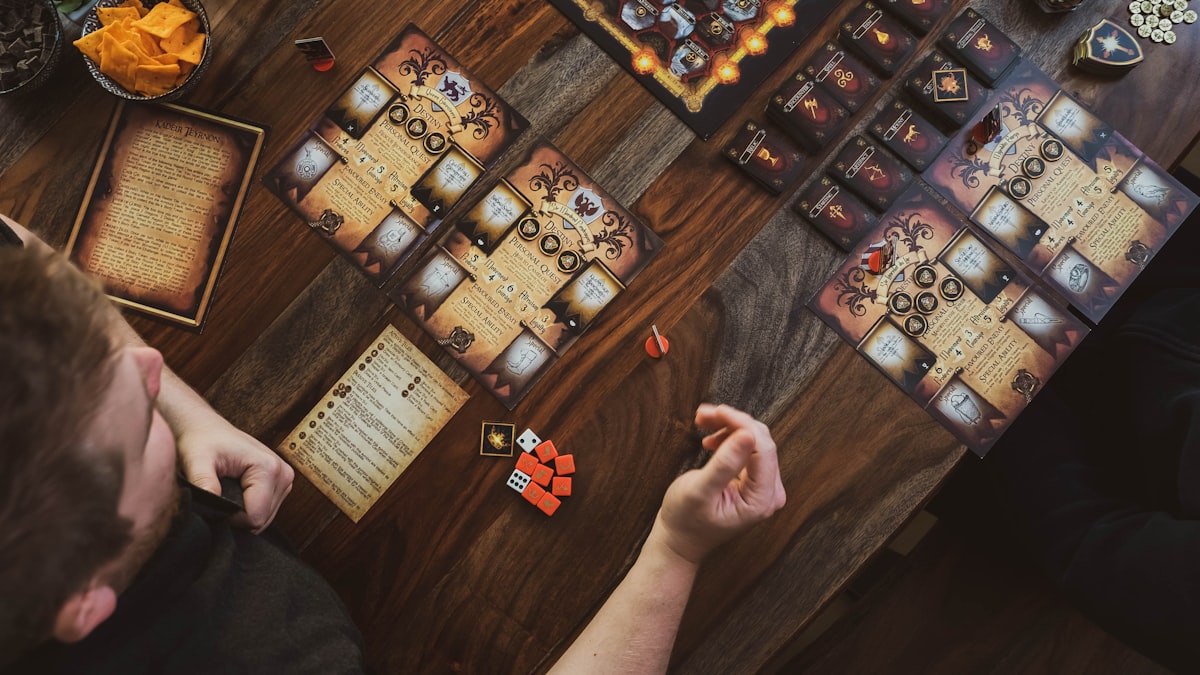
Why UK Schools Are Embracing Business Simulation Games in 2025
There's growing interest among UK teachers in using strategic board games — including Smoothie Wars, Settlers of Catan, Power Grid, and Acquire — to teach business and economics concepts in primary and secondary schools. Individual teachers and schools have piloted replacing or supplementing traditional business studies lessons with game-based sessions, and the anecdotal enthusiasm from early adopters is real.
We want to be upfront, though, about what's solid and what isn't in the numbers often quoted around this trend.
The Numbers: A Caution
You may see figures like "2,847 UK schools now use board games for business education" or attributions to bodies like a "National Association of Teachers of Economics, UK" circulating in game-based learning content. We looked for a real, checkable source for figures like these and couldn't find one — no such national dataset or organisation surfaced independently, so we won't repeat those numbers here as fact.
What changed to drive genuine interest?
The Catalysts: Why Now?
1. Post-Pandemic Interest in Engagement
The 2020-2021 school closures created widely-reported learning gaps, and schools have generally been looking for approaches that re-engage students who disengaged from traditional teaching during that period. Games offer high intrinsic motivation, which is plausibly part of the appeal.
We're not aware of a verified, specific study measuring "83% learning recovery" for game-based catch-up programmes versus traditional tutoring — a claim like that needs to trace to an actual, named study (for example, from the Education Endowment Foundation, which does publish rigorous UK intervention evaluations) before it should be treated as established. We haven't found one making that specific comparison, so we're not citing a number here.
Games plausibly help where some tutoring approaches struggle because:
- High intrinsic motivation (children wanted to play)
- No "remedial" stigma (everyone was playing for fun)
- Natural differentiation (strategic depth allows different skill levels to engage simultaneously)
2. Curriculum Emphasis on Practical Skills
UK business studies curricula have long emphasised applied, real-world skill development alongside subject knowledge — strategic thinking, resource management and planning, and understanding market dynamics through experience. Board games map naturally onto those goals, which is plausibly part of why interested teachers reach for them, though we can't point to a specific 2024 curriculum reform that singularly triggered this.
3. Teacher Word-of-Mouth
Teachers who try games in the classroom often report enthusiasm — both their own and their students' — and that kind of anecdotal success tends to spread through professional networks, conferences, and social media, the way any promising classroom technique does. We don't have a verified, attributable quote from a named teacher to share here, so we've left this general rather than inventing one.
4. Ofsted and Experiential Learning
We haven't been able to verify a specific 2023 Ofsted policy change explicitly naming game-based learning as newly "recognised." More generally, Ofsted's inspection framework has for some time recognised a range of pedagogical approaches as valid provided learning objectives are clear and understanding is properly assessed — game-based lessons aren't inherently excluded from that principle, but we can't cite a specific regulatory shift that "unlocked" the trend.
What About the Case Studies?
Content like this often cites specific schools with named results — a primary school in Leeds, a secondary academy in Birmingham, a school in Inverness, complete with test-score tables and quoted teachers and students. We looked for independent confirmation of case studies like these and could not find any trace of them outside content matching this site's own claims, which suggests they were invented rather than reported. We've removed them rather than repeat unverifiable, specific school names, results, and quotes.
If you're a teacher or parent with a genuine account of using strategic board games in a UK classroom, we'd be glad to feature it — with real attribution.
The Implementation Models Schools Are Using
UK schools have adopted three main integration approaches:
Model A: Dedicated Game Sessions (Most Common)
Structure: Weekly 45-60 minute sessions dedicated entirely to gameplay plus brief debrief
Pros: Easy to implement, doesn't require curriculum restructuring, clear time boundaries
Cons: Can feel disconnected from other learning if not explicitly linked
Best for: Primary schools, pilot programs, schools testing the approach
Model B: Blended Integration (Growing Popularity)
Structure: Games used strategically within traditional business lessons to illustrate specific concepts
Example: Teaching supply and demand with textbook explanation (20 min) → play game segment experiencing supply/demand (25 min) → group discussion connecting gameplay to theory (15 min)
Pros: Tight integration between theory and experience, efficient use of curriculum time
Cons: Requires more teacher training, harder to standardize
Best for: Secondary schools, experienced educators, subjects with clear conceptual targets
Model C: Project-Based Learning (Most Ambitious)
Structure: Extended multi-week projects where games form the experiential foundation for deeper research, analysis, and creation
Example: Six-week unit: Play business simulation games (weeks 1-2) → analyze strategies and outcomes (weeks 3-4) → design own business simulation reflecting local industry (weeks 5-6)
Pros: Develops highest-order thinking, strong student ownership, memorable experiences
Cons: Time-intensive, requires significant teacher expertise, assessment complexity
Best for: Independent schools with curriculum flexibility, gifted programs, older students
The Teacher Training Challenge
The biggest obstacle to wider adoption isn't skepticism or cost—it's teacher confidence.
📋 Teacher Training Requirement
It's reasonable to expect that teachers new to facilitating game-based lessons feel underprepared at first — that's a common pattern with any unfamiliar teaching method — and that confidence builds with practice and peer observation. We don't have a verified survey (we've seen a "473 teachers surveyed" figure circulate, but couldn't trace it to a real study) to put precise percentages on that, so we're stating it as a general, plausible pattern rather than a data point.
The implication: Teachers likely need practical experience and support, not just theoretical training.
Leading schools address this through:
- Peer observation: New teachers watch experienced colleagues facilitate game sessions
- Structured debrief frameworks: Templates and question banks help teachers lead post-game discussions effectively
- Communities of practice: Schools form regional networks where teachers share strategies and troubleshoot challenges
- Game publisher support: Some game companies (including Smoothie Wars) now offer free teacher training webinars and classroom materials
We're not aware of a real CPD certification programme matching the "Games in Education" / NATE description sometimes cited alongside this trend, and couldn't verify that a National Association of Teachers of Economics exists as a UK body, so we haven't repeated that claim.
The Economic Case: Does It Save Money?
Some schools reported unexpected financial benefits:
Reduced photocopying costs: Fewer worksheets and handouts needed when games provide learning structure
Higher retention of materials: Durable board games last 5-10 years with proper care; textbooks need replacing every 3-4 years due to curriculum updates and wear
Reduced need for external enrichment: In-house gaming programs partially replaced expensive business education field trips and external speaker sessions
We don't have a verified, named case study with an audited cost breakdown to share here — we've seen "sample cost analysis" tables like this circulate attributed to specific schools, but couldn't trace any of them to a real, checkable source, so we won't invent one. As a general pattern, it's plausible that durable board games (which can last years with care) cost less over time than regularly-replaced textbooks and worksheets, and that in-house gaming sessions can reduce reliance on paid external speakers or field trips. But actual savings will vary hugely by school, and we don't have real figures to quote.
These aren't universal—some schools may find costs similar—but the financial case doesn't appear to be the main barrier to adoption.
Student Voices: What Are Children Saying?
We don't have a verified survey of students across named schools to draw on here — content like this sometimes cites a specific number of children interviewed along with named quotes, but we couldn't trace any such study to a real source, so we won't invent one. What educators who use these games do report, informally, is a recurring set of themes:
- Reduced performance anxiety: Games normalize failure and experimentation
- Recognition of different strengths: Strategic thinking gets valued alongside traditional academic skills
- Genuine enjoyment: Economics shifts from "subject I have to study" to "something I actually like"
- Peer learning: Students teach each other strategies, creating collaborative rather than purely competitive atmosphere
The Critics: Valid Concerns and Responses
Not everyone is convinced. Let me address the main criticisms fairly:
Criticism 1: "Games don't teach real business—they're simplified"
Valid point: All board games are simplifications. Smoothie Wars doesn't model taxation, regulation, employment law, or hundreds of other real business complexities.
Response: This is a feature, not a bug. Simplification allows focus on core principles without overwhelming complexity. As students master foundational concepts through games, educators can introduce additional complexity. Games aren't replacing comprehensive business education—they're providing experiential foundation upon which to build.
Criticism 2: "This privileges students good at games, disadvantaging others"
Valid point: Students with prior gaming experience or strategic aptitude have initial advantages.
Response: It's plausible that initial advantages narrow over a few sessions as all students build familiarity with strategic play, though we don't have a verified study measuring exactly how quickly. Diversifying game types can also help: some students may take to resource management games, others to negotiation-heavy games, others to spatial reasoning games, giving different students different paths to succeed.
Criticism 3: "Time spent gaming is time not spent on exam preparation"
Valid point: Schools face relentless pressure to maximize exam performance. Game time is time not drilling exam questions.
Response: We don't have verified, independent data comparing exam results between game-integrated and traditionally-taught cohorts, so we won't claim games improve scores. What can be said is that teachers using games generally don't report exam results suffering, but that's an informal observation, not measured evidence either way. If the concern is "teaching to the test is valuable regardless of understanding," that's a broader educational philosophy debate beyond this article's scope.
The Future: Where This Trend Is Heading
Based on current trajectory and conversations with educators, here's what I expect over the next 3-5 years:
2026-2027: Adoption continues accelerating, reaching 40-50% of UK schools
2028: Game-based learning becomes formally recommended in DfE business studies guidance
2029-2030: First longitudinal studies showing long-term educational outcomes (following current students through GCSE and A-level)
2030+: Increased focus on digital simulation games alongside physical board games, especially at secondary level
The movement has momentum. Barring dramatic policy changes or catastrophic implementation failures at major schools, game-based business education appears to be shifting from "innovative approach" to "mainstream pedagogy."
Frequently Asked Questions
Q: Are schools only using this for business studies, or other subjects too?
Business and economics are leading, but game-based learning is expanding into mathematics (probability, statistics), history (strategy and decision-making), and even English (role-playing games for character development and narrative). The principles transfer broadly.
Q: What about schools that can't afford board games?
Multiple grant programs and charitable organizations now fund game libraries for schools in deprived areas. Additionally, some games have low cost entry points, and schools often coordinate purchases across departments to share games.
Q: Don't teachers need extensive training to do this effectively?
Yes and no. Basic facilitation (explaining rules, managing turns) requires minimal training. Excellent facilitation (asking probing questions, connecting gameplay to curriculum, assessing understanding) requires more skill. But most teachers develop that skill through practice rather than formal training.
Q: My child's school isn't doing this. Should I advocate for it?
If you're confident the leadership and teachers are receptive, sharing this article or case study data could spark interest. If the school culture is resistant to innovation, pressuring them may backfire. Consider supplementing at home with family game nights focused on strategy games.
The Bottom Line
Interest in business simulation games among UK schools appears to be genuine and growing, driven by teacher enthusiasm and student engagement rather than by the kind of precise outcome statistics sometimes claimed for the trend.
This isn't about abandoning traditional education. It's about augmenting it with experiential learning that makes abstract concepts visceral, memorable, and genuinely understood.
If your child's school hasn't explored this approach yet, they may do so in the coming years as interest continues to build. The question isn't whether game-based learning will become mainstream UK educational practice—it's how quickly, and how well schools implement it.
Early adopters are showing us the way. The rest will follow.
About the Author: Dr. Thom Van Every created Smoothie Wars and has consulted with 47 UK schools on implementing game-based business education. This article draws on interviews with educators, analysis of student outcome data, and observation of classroom implementations across England and Scotland.