A friend moves to Manchester. Your regular Thursday game night should be over. Except it is not, because you fire up a browser, open a digital table, and thirty seconds later you are bluffing at each other through a webcam feed instead of across a table. Board games online genuinely solved a real problem: distance.
But ask the same group what happens when everyone is actually in the same city, and most of them will tell you they still choose to drive somewhere and sit down with real cards. That preference is not nostalgia. It is worth understanding why, and where each format actually earns its place.
The genuine case for playing online
Platforms like Board Game Arena are not a compromise dressed up as a solution. They do things physical play cannot.
Setup and teardown vanish. A game that takes fifteen minutes to lay out on a table is ready in under a minute online. Rules enforcement is automatic, so nobody argues about whether a move was legal. Many platforms are free or cost a few pounds a month, which is a fraction of buying physical copies of dozens of titles. And distance stops mattering. A group scattered across three time zones can still play together on a Tuesday night.
For families with a relative abroad, or friend groups that scattered after university, this is not a lesser version of board gaming. It is the only version that is realistically possible on a given evening.
What actually gets lost
The honest answer is not "everything gets worse." It is that specific things disappear, and whether that matters depends on the game and the group.
Reading the table. Bluffing games and negotiation-heavy titles rely on body language: the hesitation before a trade, the way someone avoids eye contact after a big move. A screen flattens most of that. Video helps, but a small tile in a grid of six people is not the same as sitting across from someone.
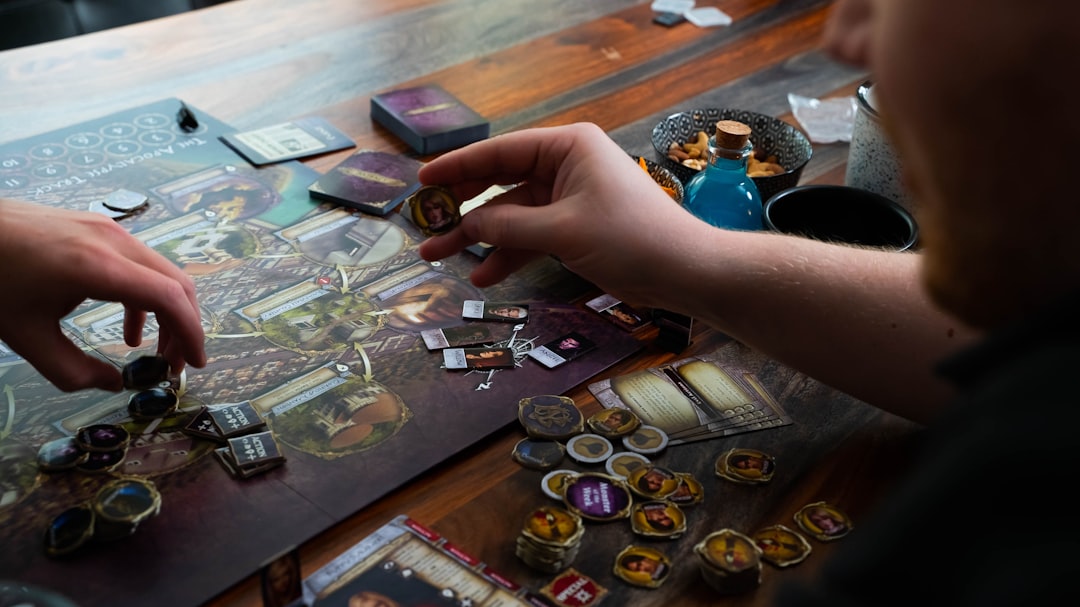
Tactile satisfaction. Shuffling real cards, stacking coins, sliding a piece across a board - these are part of why physical games feel good to play, not just win. Clicking a mouse does not replicate it, and for tactile learners especially, something is missing.
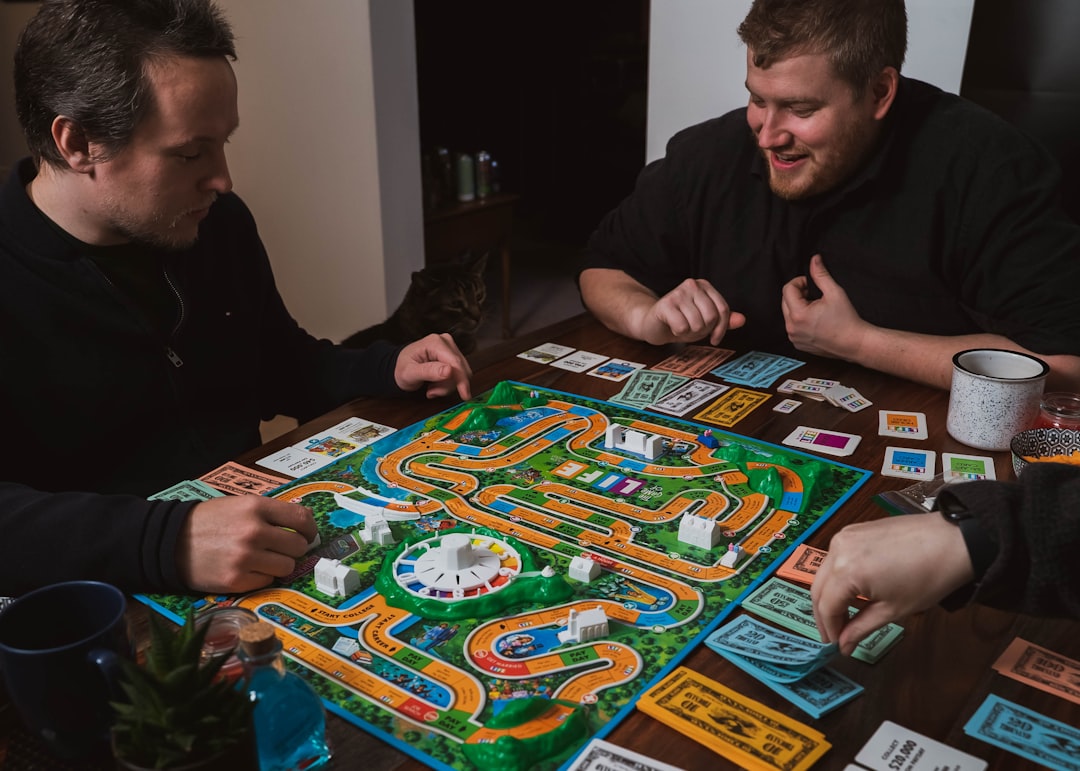
The "lean in together" energy. Around a physical table, people naturally cluster, point at the board, and talk over each other in the good way. Video calls enforce turn-taking by nature of the medium. The chaotic, overlapping energy of a great physical game night is hard to recreate through a webcam.
Screen fatigue. For anyone who works at a screen all day, opening another browser tab for leisure is not restful in the way pulling out a physical box is. This is a real and increasingly common complaint, not a minor gripe.
TL;DR
- Board games online are genuinely useful for distance, cost, and convenience - not a lesser format, a different one.
- Physical play keeps things online struggles to replicate: reading people, tactile feedback, and the shared energy of a table.
- The choice is not either-or. Many groups use online for midweek convenience and physical for weekends when everyone can meet.
- Bluffing, negotiation, and social deduction games lose the most online; abstract strategy games often translate well.
A tale of two game nights
A group of six former university housemates, now spread between Bristol, Leeds, and London, settled into a rhythm over the past two years. Midweek, when nobody can travel and everyone is tired after work, they play on Board Game Arena - usually something quick and low-stakes, finished in under an hour. Weekends, when three or four of them can actually get to the same city, they meet at whoever's flat has the biggest table and play something with real components: a negotiation game, a deduction game, something that rewards watching each other's faces.
Nobody in the group treats one as a replacement for the other. The online sessions keep the friendship ticking over. The physical sessions are the ones people talk about afterwards.
How online and physical play actually compare
Board games online vs physical play, by what actually matters
| Factor | Online play | Physical play |
|---|---|---|
| Cost | Often free or low monthly fee | Games cost £15 to £50+ each, one-off |
| Setup effort | Under a minute | 5 to 20 minutes depending on game |
| Social presence | Reduced; video helps but flattens body language | Full - tone, posture, hesitation all visible |
| Tactile experience | None - clicks and taps | Real cards, tokens, boards |
| Accessibility for remote friends | Excellent - distance is irrelevant | Requires everyone in one room |
| Best use case | Quick sessions, distant friends, trying a game before buying | Regular game nights, bluffing/negotiation games, screen-free time |
What in-person club organisers tend to say
People who run weekly in-person meetups are usually not precious about online play - many use it themselves when a regular player moves away. But it is a common observation among club organisers that newcomers discover, almost with surprise, that a negotiation game is a completely different experience with real people at a real table. The pauses matter. The way someone fiddles with their cards when they are bluffing matters. That is not information a screen conveys well, and for certain games, that information is most of the fun.
People also ask
Is Board Game Arena free?
Board Game Arena offers a free tier with a rotating selection of games, plus a paid premium membership that unlocks the full catalogue and removes limits on simultaneous games. For families wanting to try a wide range of titles before committing to physical copies, the free tier is a reasonable starting point.
Can you replicate a physical board game experience online?
Not fully, and most serious players do not claim otherwise. Online platforms replicate the rules and the turn structure well. They replicate the social and tactile experience poorly, which is precisely why many groups treat online and physical play as separate, complementary habits rather than substitutes for each other.
Which games work best online versus in person?
Abstract strategy and resource-management games, where the board state is all the information you need, tend to translate well online. Bluffing, negotiation, and social deduction games lose the most, since so much of the fun depends on reading other players, which a webcam only partially captures.
🔑 Key Takeaways
- ✓Online platforms win on cost, setup time, and connecting distant friends - treat them as a genuine format, not a lesser one.
- ✓Physical play keeps the social and tactile layer that bluffing and negotiation games depend on.
- ✓Many groups run both: online midweek for convenience, physical at weekends for the sessions that matter more.
- ✓If your game nights have drifted entirely online, a deliberately physical-only game like Smoothie Wars can bring the table back.
FAQs
Do I need to choose one format over the other? No. Most active game groups use both, choosing online for convenience and physical play for the sessions that matter more socially.
Is online play cheaper long-term? Usually yes in pure subscription terms, but physical games are a one-off cost that you own indefinitely and can play with anyone, anywhere, without a screen or an account.
Why do bluffing games suffer most online? Because their core mechanic depends on reading physical tells - hesitation, eye contact, fidgeting - which a video call compresses into a small, delayed, poorly lit window.
Is BoardGameGeek useful if I mostly play online? Yes. BoardGameGeek is a reference database and community independent of any platform, useful for research and reviews regardless of how you actually play.
What if my group has screen fatigue from work? This is exactly the case where physical play earns its keep. A box on the table, real cards in hand, and no browser tab in sight is a genuinely different kind of evening than another video call, even a fun one.
The case for keeping cardboard in your life
Board Game Arena and platforms like it are not going anywhere, and they should not have to justify their existence - they solved a real problem for scattered friend groups and busy families. But if your game nights have quietly drifted entirely online, it is worth asking whether you are missing the parts that made game night worth having in the first place: the lean-in moment when someone makes a bold trade, the groan when a plan falls apart, the shuffle of real cards at the start of a new round.
Smoothie Wars was built for that table, deliberately. It is a physical-only strategy game for 3 to 8 players, ages 12 and up, designed by Dr Thom Van Every to reward reading the room as much as reading the board - watching who is short on cash, who is bluffing about their next move, who is quietly cornering a location. None of that comes through a screen quite the same way. If your group has a real game night in them somewhere, see what Smoothie Wars is about and bring back the table.