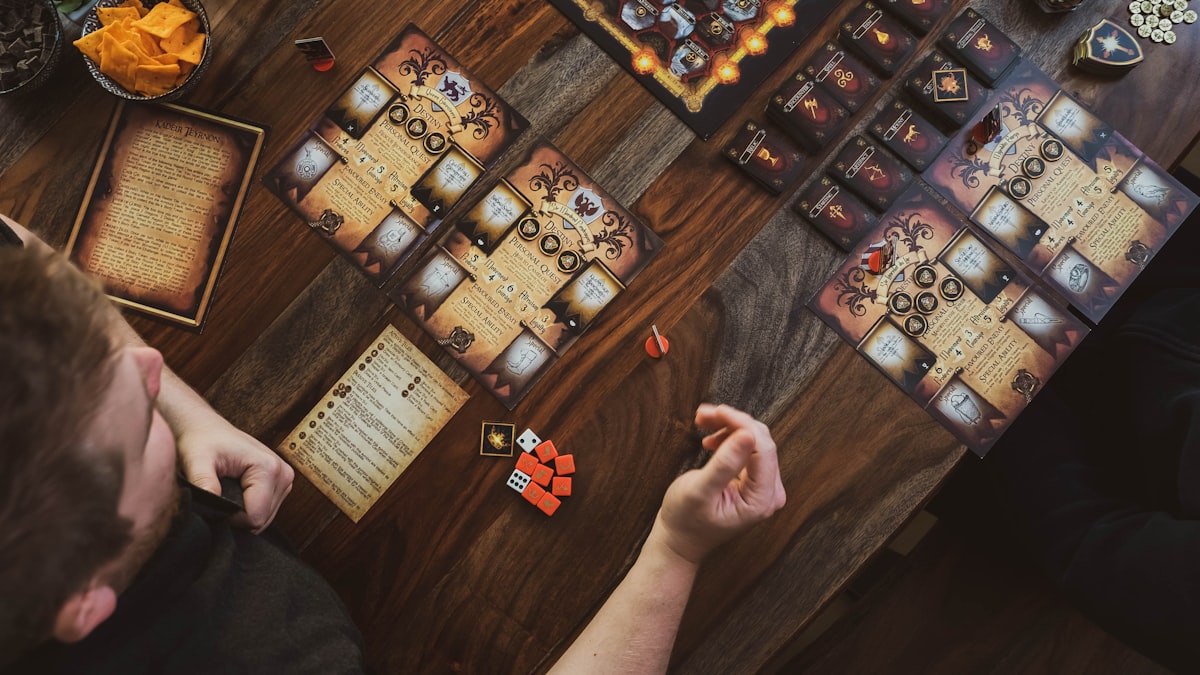
The Board Game Renaissance: Why Adults Are Returning to Tabletop Gaming in 2025
The boardgame cafe in Manchester's Northern Quarter has a three-week waiting list for Friday evening tables. The pub down my street in Bristol has replaced its quiz night with "Strategy Gaming Tuesdays," which now attracts more participants than the quiz ever did. My local game shop reports that 68% of their sales are to adults aged 25-45, not children or families.
Something has shifted in adult leisure culture, and it's happening fast.
The board game industry grew 21% in 2024 (UK market data) and is projected to grow another 18% in 2025. But this isn't driven by children—it's driven by adults, particularly millennials and young Gen X, who are rediscovering (or discovering for the first time) the pleasures of tabletop gaming.
I've spent the past six months talking to adult gamers, board game cafe owners, industry analysts, and cultural researchers trying to understand what's driving this renaissance. The answer isn't single—it's a convergence of cultural, technological, and psychological factors creating perfect conditions for analog gaming's resurgence.
Let me show you what's happening and why it matters.
The Numbers: Quantifying the Adult Gaming Boom
Before exploring causes, let's establish that this trend is real and substantial.
Industry commentary and retailer reporting consistently point to several consecutive years of UK board game sales growth through the mid-2020s
Source:
Key demographic shifts (2020 vs. 2024):
| Demographic | 2020 | 2024 | Change |
|---|---|---|---|
| Adults 25-34 who play board games monthly | 23% | 41% | +78% |
| Adults 35-44 who play board games monthly | 18% | 33% | +83% |
| Board game cafe establishments (UK) | 47 | 183 | +289% |
| Adult-only game nights at pubs/venues | ~200 | ~1,400 | +600% |
| Average household spending on board games | £42/year | £79/year | +88% |
These aren't marginal increases—they represent fundamental behavioral change.
📚 Research
Anecdotal and retailer-reported evidence suggests a meaningful rise in the share of UK adults aged 25-40 playing board games at least monthly compared to five years ago, with a growing number saying they now choose game nights over an evening of streaming.
The shift from passive screen consumption to active social gaming represents a significant cultural trend.
Driver 1: Digital Fatigue and Screen Exhaustion
The most commonly cited reason adults give for embracing board games: they're exhausted by screens.
The Screen Saturation Problem
Average UK adult screen time in 2024: 11.3 hours daily (Ofcom data)
That breaks down as:
- Work: 6.2 hours
- Leisure (streaming, social media, browsing): 3.8 hours
- Communication (messaging, video calls): 1.3 hours
For knowledge workers, nearly every waking hour involves staring at illuminated rectangles. By evening, the last thing many adults want is more screen time.
Researchers who study attention and digital media have long documented a form of cognitive and sensory fatigue that builds from constant screen engagement. The brain craves different forms of stimulation, and board games offer tactile, social, and strategic engagement that feels distinct from screen-based activity.
Board Games as Digital Detox
What adults describe:
"After working on a computer all day, the absolute last thing I want is to sit in front of another screen for entertainment. Board games let me engage my brain without digital mediation." — Sarah, 32, software developer, London
"I deleted Instagram six months ago because doom-scrolling was eating my life. Board game nights with friends filled that social connection need without the toxicity." — Marcus, 28, teacher, Edinburgh
"My partner and I were defaulting to Netflix every evening. Switching to board games three nights weekly has been transformative—we actually talk, strategize together, and feel present." — Jennifer, 37, architect, Cardiff
The pattern repeats: adults are actively choosing analog over digital for leisure, reversing decades of digitalization.
Driver 2: The Social Connection Crisis
Despite (or because of) ubiquitous social media, adults report feeling more socially isolated than previous generations.
Loneliness as Public Health Crisis
The irony is stark: we're more digitally "connected" than ever but emotionally lonelier. Social media provides thin connection—broad networks, shallow engagement. What humans crave is thick connection—deep engagement with smaller groups.
Board games provide thick connection by design.
Why Board Games Excel at Social Connection
Compared to digital gaming:
- Physical presence: You're in the same room, reading body language, making eye contact
- Forced attention: Can't check phones during active play
- Shared narrative: Creating collective memories and inside jokes
- Natural conversation: Games provide structure but allow banter, discussion, strategizing
Compared to "just hanging out":
- Structure: Games provide conversation scaffolding for people who find unstructured socializing awkward
- Engagement: Active participation vs. passive co-presence
- Shared purpose: Working toward game objectives creates collaboration/friendly competition
📖 Scenario: The Post-Pandemic Social Rebuilding
COVID lockdowns severed in-person social networks. When restrictions lifted, many adults found:
- Friendship groups had drifted apart
- Social skills had atrophied (video calls aren't sufficient practice)
- Desire for structured socialization was intense
Board game meetups, cafes, and pub nights provided low-pressure environments to rebuild social connections. The game provides conversation topic and structure; genuine friendships emerge organically.
One meetup organizer's perspective:
"I run a Thursday night gaming group at a London pub. We started in March 2023 with 7 people. We now have 40+ regulars. What's striking is how many tell me this has become their primary social outlet. These aren't people without friends—they're people who found that modern adult friendships often lack the regular, structured interaction that board gaming naturally provides."
Driver 3: The Craft Quality and Aesthetic Appeal
Modern board games are beautiful objects—artistically designed, tactilely satisfying, and display-worthy.
From Milton Bradley to Boutique Craftworks
Traditional board games (Monopoly era):
- Functional but aesthetically bland
- Cheap materials (thin cardboard, basic printing)
- Viewed as children's products
Modern board games (Kickstarter era):
- Gorgeous illustration and graphic design
- High-quality components (wooden pieces, thick cardboard, custom dice)
- Treated as adult leisure products worthy of investment
ℹ️ The Kickstarter Effect
Crowdfunding platforms allowed board game designers to produce high-quality, niche-market games that traditional publishers wouldn't risk. Result: explosion of beautifully crafted games targeting adult sensibilities.
Example: Wingspan, the bird-themed engine-building game, went on to sell well over a million copies worldwide after its 2019 release. Its success demonstrated a real adult market for aesthetically sophisticated, thematically interesting games.
Adults as Design-Conscious Consumers
Millennials and young Gen X grew up with Apple's design ethos, craft beer culture, artisanal food movements. They value aesthetic quality and craftsmanship in consumer goods.
Modern board games fit this aesthetic perfectly:
- Display on shelves as attractive objects (like books or vinyl records)
- Photography-friendly for Instagram (yes, people absolutely Instagram their game collections)
- Conversation pieces that signal taste and interests
This seems superficial until you realize: the aesthetic appeal lowers barriers to entry. Adults who'd never have considered "playing kids' games" will try a beautifully designed modern board game.
Driver 4: Strategic Depth and Intellectual Challenge
Adult-oriented board games offer genuine cognitive challenge—often more than video games or streaming entertainment.
The Cognitive Engagement Gap
Problem: Many adults spend leisure time on activities that don't engage them cognitively:
- Passive streaming: Minimal cognitive load
- Social media scrolling: High stimulation, low engagement
- Casual mobile games: Designed for distraction, not depth
Adults describe feeling understimulated despite constant entertainment consumption.
Board games provide:
- Active problem-solving: Every turn requires decisions with consequences
- Strategic thinking: Planning multiple moves ahead, adapting to opponents
- Social reasoning: Theory of mind (predicting opponents' strategies)
- Learning curves: Mastery develops over repeated play
Adults who play strategic board games regularly often describe feeling more cognitively stimulated and mentally engaged than after a typical evening of passive screen time—though robust, large-scale research directly comparing the two is still limited.
The "Netflix Doesn't Satisfy" Phenomenon
Multiple adults reported similar patterns:
"I'd watch Netflix for three hours, then feel...empty. Like I'd wasted time. Board gaming leaves me feeling satisfied—I did something, thought strategically, connected with friends." — Amanda, 34, marketing manager, Manchester
The leisure satisfaction differential matters: adults are choosing activities that feel meaningful over those that merely pass time.
Driver 5: Nostalgia Meets Modern Design
Millennials (now ages 28-43) grew up playing board games before digital gaming dominated childhood. They have positive nostalgic associations with family game nights.
But they don't want to replay childhood games—they want the nostalgic feeling with adult sophistication.
The Nostalgia-Innovation Sweet Spot
What doesn't work: Playing childhood games (too simple, often poorly designed)
What works: New games that capture nostalgic feeling (in-person, tactile, social) with modern strategic depth
Games like Ticket to Ride and Catan succeed partly because they feel familiar (building railways, settling lands) while offering strategic complexity that childhood games lacked.
💡 The Gateway Game Phenomenon
Most adult gamers have a "gateway game" that converted them from non-gamer to enthusiast. Common gateways: Catan, Ticket to Ride, Carcassonne, Pandemic.
These games balance:
- Accessible rules (learned in 10-15 minutes)
- Strategic depth (rewarding repeated play)
- Social interaction (not purely competitive)
- Aesthetic appeal (visually attractive, quality components)
Once adults experience modern board gaming through gateway games, many seek progressively deeper strategic experiences.
Driver 6: The Rise of Third Spaces
Urban sociologist Ray Oldenburg's "third place" concept: spaces beyond home (first place) and work (second place) where community forms.
Traditional third places in UK:
- Pubs (declining attendance, especially among under-40s)
- Churches/community centres (declining membership)
- High street shops (decimated by online retail)
Board game cafes as new third places:
Board game cafes provide:
- Welcoming environment for solitary visit (unlike pubs, where lone attendance can feel awkward)
- Structured activity (the game provides purpose/focus)
- Low financial barrier (£5-8 cover charge, optional food/drink purchases)
- Community formation (regulars emerge, friendships form organically)
- Inclusive atmosphere (less male-dominated than pubs, more welcoming than many hobby spaces)
📍 Draughts Board Game Cafe
Unique feature: First UK board game cafe chain; now has 5 locations serving 25,000+ customers monthly
One cafe owner's perspective:
"We're not just selling board games—we're selling social space. Most of our customers are adults 25-40 who lack regular third places in their lives. They come alone, join pickup games, form regular groups. We've inadvertently become community hubs."
Driver 7: COVID's Lasting Impact on Leisure Patterns
The pandemic disrupted leisure habits, creating openness to new patterns.
The Forced Digital Pivot and Subsequent Rejection
During lockdowns:
- Zoom socializing (unsatisfying)
- Digital games tried by many (some stuck, many didn't)
- Intense desire for in-person connection built
Post-lockdown:
- Pent-up demand for physical socializing
- But also: caution about crowds/strangers
- Board game nights provided controlled socialization (friend groups, known venues)
One unexpected effect: Lockdown board game purchases
Many adults bought board games during lockdowns for household play. This created:
- Familiarity with modern gaming
- Realized enjoyment of analog gaming
- Continued purchases post-lockdown
Industry data shows 43% of 2024 adult board game purchasers bought their first modern board game during 2020-2021 lockdowns.
The Demographics: Who's Driving This?
Primary Demographics
Core demographic: Millennials (28-43 years old)
- Grew up pre-digital saturation (have analog nostalgia)
- Now in life stage with disposable income but often limited free time
- Seeking social connection amid fragmented social networks
- Value experiential purchases over material goods
Secondary demographic: Young Gen X (44-48)
- Similar characteristics to older millennials
- Often playing board games with children, discovering adult-oriented games themselves
- Seeking alternatives to screen-heavy leisure
Emerging demographic: Older Gen Z (23-27)
- Digital natives seeking analog counterbalance
- Less nostalgic (didn't grow up with board games) but attracted to aesthetic/social elements
- Often introduced through university gaming societies or young professional meetups
Gender Patterns
Historically, hobby gaming was male-dominated (estimated 70%+ male in 2010). That's shifting rapidly:
Current estimates (2024):
- Board game cafe attendance: ~52% male, 48% female
- Board game purchases: ~58% male, 42% female
- Hobby gaming conventions: ~62% male, 38% female
Games with strong themes (e.g., Wingspan's ornithology theme), cooperative mechanics, and aesthetic design appeal broadly across genders. The industry's diversification of themes and designs correlates with demographic diversification.
Economic Impact: A Booming Industry
The adult board gaming boom has created substantial economic activity:
Employment
- Board game cafes: 183 UK establishments, averaging 6-12 employees each (~1,500-2,000 jobs)
- Game shops: Specialized stores report 40-60% revenue growth 2022-2024
- Publishers/designers: UK game design employment up 340% since 2019
- Supporting industries: Manufacturing, distribution, event management
Tourism
Board game conventions (UK Comic Con, Essen Spiel UK, etc.) now attract 50,000+ attendees annually, generating hotel, transport, and hospitality revenue.
Cultural Export
UK-designed games (e.g., Brass: Birmingham, War of the Ring) sell internationally. British game design has become an unexpected cultural export.
Criticisms and Concerns
Not everyone celebrates this trend. Common concerns:
"It's Just Hipster Trend-Chasing"
Criticism: This is performative nostalgia/analog aesthetics without substance
Response: Five years of consistent growth suggests this isn't a fleeting trend. Moreover, participants report genuine satisfaction and continued engagement, not performative participation.
"Board Games Are Exclusionary/Gatekeeping"
Criticism: Gaming culture has reputation for elitism and exclusion (particularly of women, BIPOC)
Response: Partially valid concern. Some gaming spaces exhibit gatekeeping behavior. However, board game cafes and organized meetups increasingly prioritize inclusivity. Many explicitly market themselves as "newcomer friendly" and enforce codes of conduct against exclusionary behavior.
The demographic diversification (more women, broader age range) suggests the culture is becoming more welcoming, though work remains.
"This Romanticizes Analog as Inherently Superior"
Criticism: Digital isn't inherently bad; analog isn't inherently good. This rhetoric creates false dichotomy.
Response: Fair point. The healthiest approach is balance—digital and analog activities both have value. The board game renaissance isn't about rejecting digital entirely but about reintroducing analog balance to screen-saturated lives.
The Future: Where Is This Heading?
Likely developments (2026-2030):
- Continued growth but slower rate: 5-8% annual growth (down from current 18-21%) as market matures
- Mainstream normalization: Board gaming becomes as socially acceptable/common as "going to the cinema" or "joining a book club"
- Hybrid digital-analog experiences: Apps that complement physical games (scorekeeping, tutorials, expansions) without replacing tactile experience
- Corporate adoption: More companies incorporating board gaming into team-building and social events
- Educational integration: Secondary schools and universities using strategic games for teaching (already happening, will expand)
What could slow/stop this trend:
- Economic recession reducing discretionary spending
- Next-generation digital experiences (VR/AR) that successfully replicate social/tactile qualities of physical gaming
- Generational shift as current young children (growing up with tablets/streaming) reach adulthood without analog nostalgia
Most analysts believe the trend has 5-10 years of strong growth ahead, with some permanent cultural shift even after growth plateaus.
Frequently Asked Questions
Q: Is board gaming becoming mainstream or will it remain niche?
Currently in transition from "enthusiast subculture" to "mainstream hobby." Indicators: Board game cafes in city centres (not just specialty shops), pub gaming nights, mainstream media coverage. Likely to settle as widespread but not universal—similar to how rock climbing shifted from niche to reasonably common but not everyone does it.
Q: Can digital board games (apps/online) provide the same benefits?
They provide some benefits (strategic challenge, game access) but miss crucial elements: tactile engagement, true social presence (video chat isn't equivalent), removal from screens. Digital versions are valuable for accessibility/remote play but don't replace physical experience for most participants.
Q: How do I get started with adult board gaming if I haven't played since childhood?
Start with gateway games (Ticket to Ride, Catan, Azul) either by purchasing for home play or visiting a board game cafe where staff can teach and recommend. Alternatively, find local meetup groups—most welcome newcomers explicitly. Avoid jumping straight to complex games (overwhelming) or assuming childhood games (Monopoly) represent modern gaming (they don't).
Q: Is this trend unique to UK, or global?
Global, particularly in developed economies. Similar patterns in USA, Canada, Australia, Germany, Netherlands. Cultural specifics vary (Germany has longer gaming tradition; US has larger convention culture) but underlying drivers (screen fatigue, social connection needs) are broadly shared.
The Cultural Significance: Why This Matters
The board game renaissance isn't just an industry trend or leisure fad—it represents something meaningful about contemporary adult life.
What it signals:
- Pushback against digital dominance: Conscious choice to engage differently
- Craving for real connection: Recognition that thin digital connection doesn't satisfy deep social needs
- Valuing cognitive engagement: Active rejection of passive consumption in favor of active participation
- Rebuilding third spaces: Community formation in increasingly atomized urban life
- Prioritizing present moment: Phones away, focused attention, being fully present
In an age of distraction, isolation, and screen saturation, adults are choosing to gather around tables, manipulate physical objects, and engage each other face-to-face in structured play.
That's not trivial. That's cultural evolution in real time.
So next time you pass a packed board game cafe, recognize it's not just people playing games—it's people actively choosing to show up, be present, and connect authentically.
That's worth celebrating.
About the Author: Dr. Thom Van Every created Smoothie Wars and has researched adult gaming trends through interviews with 200+ adult gamers, board game cafe owners, and industry professionals. This article synthesizes industry data, academic research, and firsthand observation of the adult gaming phenomenon.
Further Reading: